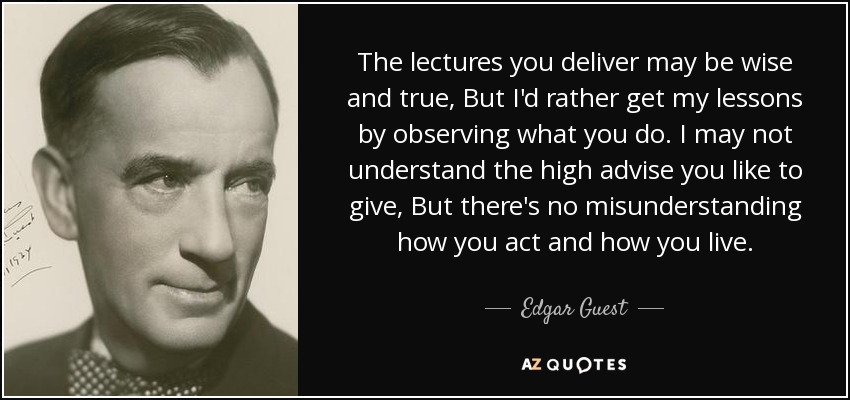
The lectures you deliver may be wise and true, But I'd rather get my lessons by observing what you do. I may not understand the high advise you like to give, But there's no misunderstanding how you act and how you live.
What clinical lectures I will give in heaven, demonstrating the ignorance of doctors!
PANDEMONIUM, n. Literally, the Place of All the Demons. Most of them have escaped into politics and finance, and the place is now used as a lecture hall by the Audible Reformer.
A man may have intelligence enough to excel in a particular thing and lecture on it, and yet not have sense enough to know he ought to be silent on some other subject of which he has but a slight knowledge; if such an illustrious man ventures beyond the bounds of his capacity, he loses his way and talks like a fool.
You cannot lecture on really pure poetry any more than you can talk about the ingredients of pure water-it is adulterated, methylated, sanded poetry that makes the best lectures.
Most people tire of a lecture in ten minutes; clever people can do it in five. Sensible people never go to lectures at all. But the people who do go to a lecture and who get tired of it, presently hold it as a sort of grudge against the lecturer personally. In reality his sufferings are worse than theirs.
I will gladly lecture for fifty dollars, but I'll not be a guest for less than a hundred.
Henceforward, I shout to the heavens, I shall deliver no more lectures on behalf of good causes: I am the good cause that denies the need for such lectures. Avaunt, importuning world! Back to my cell.
Efforts to develop critical thinking falter in practice because too many professors still lecture to passive audiences instead of challenging students to apply what they have learned to new questions.
The modern school without systematic lectures turns out many graduates who lack retention. No sooner has the sound of the word left their teacher's lips, the subject has been forgotten.
I am giving this winter two courses of lectures to three students, of which one is only moderately prepared, the other less than moderately, and the third lacks both preparation and ability. Such are the onera of a mathematical profession.
I have a true aversion to teaching. The perennial business of a professor of mathematics is only to teach the ABC of his science; most of the few pupils who go a step further, and usually to keep the metaphor, remain in the process of gathering information, become only Halbwisser [one who has superficial knowledge of the subject], for the rarer talents do not want to have themselves educated by lecture courses, but train themselves. And with this thankless work the professor loses his precious time.
To the distracting occupations belong especially my lecture courses which I am holding this winter for the first time, and which now cost much more of my time than I like. Meanwhile I hope that the second time this expenditure of time will be much less, otherwise I would never be able to reconcile myself to it, even practical (astronomical) work must give far more satisfaction than if one brings up to B a couple more mediocre heads which otherwise would have stopped at A.
If I waited to be in the mood to write, I'd barely have a chapbook of material to my name. Who would ever be in the mood to write? Do marathon runners get in the mood to run? Do teachers wake up with the urge to lecture? I don't know, but I doubt it. My guess is that it's the very act that is generative. The doing of the thing that makes possible the desire for it.
Focus on the mind and the soul. Read. Study. Enrol in a course of lectures. Pray. Become a member of a religious congregation. Study the Bible or other ancient works of wisdom.
I delivered lectures, and I was also a consultant for international companies in finance, both private equity and big venture capital funds.
I thought I would be an organic chemist. I went off to university, and when I couldn't understand the chemistry lectures I decided that I would be a zoologist, because zoologists seemed like life-loving people.
We don't need flowery words about inequality to tell us that, and we don't need a party that has led while poverty and hunger rose to record levels to give us lectures about suffering.
Modern science gives lectures on botany, to show there is no such thing as a flower; on humanity, to show there is no such thing as a man; and on theology, to show there is no such thing as a God. No such thing as a man, but only a mechanism, No such thing as a God, but only a series of forces.
Medicine is learned by the bedside and not in the classroom. Let not your conceptions of disease come from words heard in the lecture room or read from the book. See, and then reason and compare and control. But see first.
If for the sake of a crowded audience you do wish to hold a lecture, your ambition is no laudable one, and at least avoid all citations from the poets, for to quote them argues feeble industry.
Often in my lectures when I use the phrase “imperialist white-supremacist capitalist patriarchy” to describe our nation’s political system, audiences laugh. No one has ever explained why accurately naming this system is funny. The laughter is itself a weapon of patriarchal terrorism.
How many more years will our educators continue to lecture us on the evils of whipping children until they bring home high grades? Year after year we listen to these fellows tell us that it is not the grade that counts but the development of the child's personality. After the lecture they go back to all the best schools and reject our children because they have C averages.
I recall a lecture by John Glenn, the first American to go into orbit. When asked what went through his mind while he was crouched in the rocket nose-cone, awaiting blast-off, he replied, "I was thinking that the rocket has 20,000 components, and each was made by the lowest bidder."
My general impression about people like Steve Gould and Carl Sagan and so on is that when they disappear as individuals and are no longer appearing on the stage and they are no longer writing, that their lifetime of acknowledgement by the general reading public is not very long... There were many people in the 19th century who were equally famous people who gave working man's lectures, supporters of Darwin, we as scholars know their names but the general public never heard of them.
Follow AzQuotes on Facebook, Twitter and Google+. Every day we present the best quotes! Improve yourself, find your inspiration, share with friends
or simply: