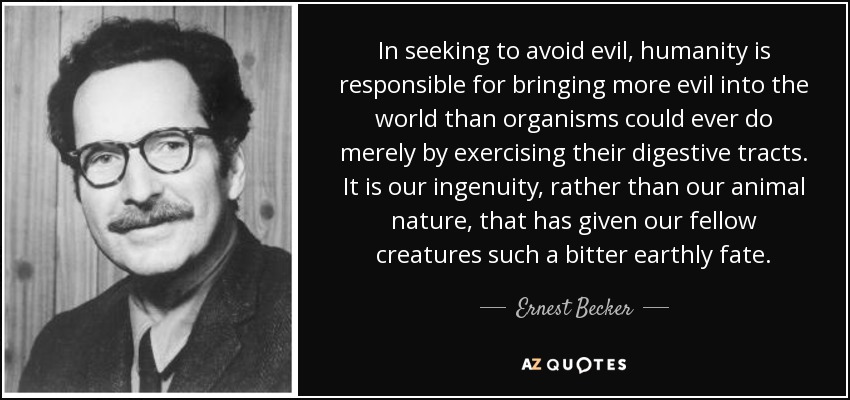
In seeking to avoid evil, humanity is responsible for bringing more evil into the world than organisms could ever do merely by exercising their digestive tracts. It is our ingenuity, rather than our animal nature, that has given our fellow creatures such a bitter earthly fate.
Every living body continuously eliminates feces, it rejects what is not serviceable to the assimilating organism: what man despises, what arouses his disgust, what he calls evil, are excrements.
Appealing to his [Einstein's] way of expressing himself in theological terms, I said: If God had wanted to put everything into the universe from the beginning, He would have created a universe without change, without organisms and evolution, and without man and man's experience of change. But he seems to have thought that a live universe with events unexpected even by Himself would be more interesting than a dead one.
We must believe in a sense of life renewed by the theater, a sense of life in which man fearlessly makes himself master of what does not yet exist, and brings it into being. And everything that has not been born can still be brought to life if we are not satisfied to remain mere recording organisms.
We may treat of the Soul as in the body - whether it be set above it or actually within it - since the association of the two constitutes the one thing called the living organism, the Animate.Now from this relation, from the Soul using the body as an instrument, it does not follow that the Soul must share the body's experiences: a man does not himself feel all the experiences of the tools with which he is working.
Let us ask... how things work at the level of on-going subjugation, at the level of those continuous and uninterrupted processes which subject our bodies, govern our gestures, dictate our behaviors, etc... we should try to discover how it is that subjects are gradually, progressively, really and materially constituted through a multiplicity of organisms, forces, energies, materials, desires, thoughts, etc. We should try to grasp subjection in its material instance as a constitution of subjects.
No practical biologist interested in sexual reproduction would be led to work out the detailed consequences experienced by organisms having three or more sexes; yet what else should he do if he wishes to understand why the sexes are, in fact, always two?
If you look at how many thousands and thousands of pages, Web pages, are being added to the Internet every day, it's the fastest growing organism in human history for communications.
The industrial-technological system may survive or it may break down. If it survives, it MAY eventually achieve a low level of physical and psychological suffering, but only after passing through a long and very painful period of adjustment and only at the cost of permanently reducing human beings and many other living organisms to engineered products and mere cogs in the social machine.
The underlying reason for convergence seems to be that all organisms are under constant scrutiny of natural selection and are also subject to the constraints of the physical and chemical factors that severely limit the action of all inhabitants of the biosphere. Put simply, convergence shows that in a real world not all things are possible.
Any attempt to reduce the complex properties of biological organisms or of nervous systems or of human brains to simple physical and chemical systems is foolish.
So if hunger provokes wailing and wailing brings the breast; if the breast permits sucking and milk suggests its swallow; if swallowing issues in sleep and stomachy comfort, then need, ache, message, object, act, and satisfaction are soon associated like charms on a chain; shortly our wants begin to envision the things which well reduce them, and the organism is finally said to wish.
Where philosophy ends, poetry must commence. There should not be a common point of view, a natural manner of thinking which standsin contrast to art and liberal education, or mere living; that is, one should not conceive of a realm of crudeness beyond the boundaries of education. Every conscious link of an organism should not perceive its limits without a feeling for its unity in relation to the whole. For example, philosophy should not only be contrasted to non-philosophy, but also to poetry.
At this point, an urgent question arises: [...] Is it our duty to seek to become a thorough and complete human being, one quite sufficient unto himself; or, on the contrary, to be only a part of a whole, the organ of an organism? Briefly, is the division of labor, at the same time that it is a law of nature, also a moral rule of human conduct; and, if it has this latter character, why and in what degree?
Man is an organism, not a mechanism; and the mechanical pacing of his life does harm to his human responses, which naturally follow a kind of free rhythm.
The loss of India would mark and consummate the downfall of the British Empire. That great organism would pass at a stroke out of life into history.From such a catastrophe there could be no recovery.
Ageing is very rare. We only see it in humans and laboratory animals and in zoo animals and in our pets. Basically, organisms that are protected from the external world. Once you create that protection, you live long enough to see ageing.
The soul is something which contains the body. The body doesn't contain the soul. The soul, if we put it into modern language, is the entire complex of relationships in whose context this organism exists.
We ourselves are part of a guild of species that lie within and without our bodies. Aboriginal peoples and the Ayurvedic practitioners of ancient India have names for such guilds, or beings made up (as we are) of two or more species forming one organism. Most of nature is composed of groups of species working interdependently.
So far, I've only sailed in the Caribbean. I've sailed the Virgin Island and The Grenadines. I liked all that. We charted some really crummy boats in the Grenadines. That made for an exciting sailing trip (laughs) when everything goes well. When everything goes well. When sails rip, engines freeze up and you find there are organisms growing inside the diesel, it's terrible and amazing stuff.
All things considered, I can see no reason to adopt the afterlife hypothesis. I am sure I shall remain in a minority for a long time to come, especially among experiencers, but for me the evidence and the arguments are overwhelming ... We are biological organisms, evolved in fascinating ways for no purpose at all and with no end in mind. We are simply here and this is how it is. I have no self and "I" own nothing. There is no one to die. There is just this moment, and now this, and now this.
The basic formulation, or bare-bones mechanics, of natural selection is a disarmingly simple argument, based on three undeniable facts (overproduction of offspring, variation, and heritability) and one syllogistic inference (natural selection, or the claim that organisms enjoying differential reproductive success will, on average, be those variants that are fortuitously better adapted to changing local environments, and that these variants will then pass their favored traits to offspring by inheritance).
I like the process of giving control away [at the recording]. When you give it up to people, it's another intelligent organism that digests your information completely differently from how a machine digests information. It's like you're on a sailboat, and every time you can find out how to better adjust [the sail] to make it more precise. And it's interesting to see that the musicians have their own ideas. To use their intuitive power with their knowledge that they incorporate into the music. This is the moment you give away control, you give it to someone else's intuition.
All organisms vary, and it's just folk knowledge. You just have to look around a room of people, and everybody knows that it's true. Darwin didn't know the mechanism of heredity, but you don't have to. You just need to know the fact of it.
You put three facts together - that all organisms produce more offspring that can survive, that there's variation among organisms, and that at least some of that variation is inherited - and the syllogistic inference is natural selection.
Follow AzQuotes on Facebook, Twitter and Google+. Every day we present the best quotes! Improve yourself, find your inspiration, share with friends
or simply: