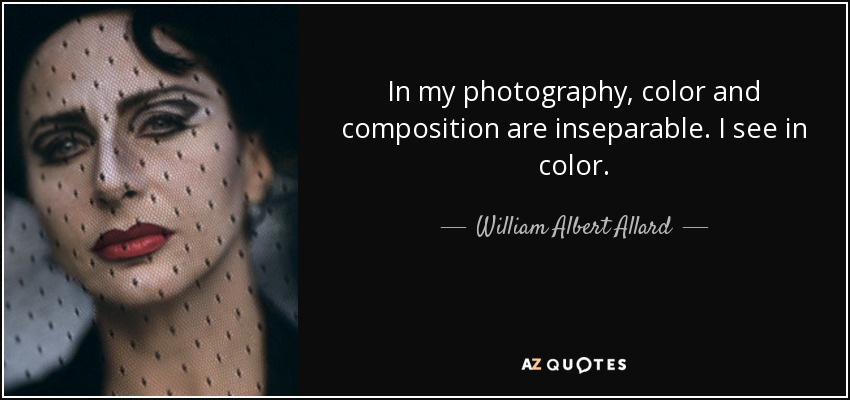
In my photography, color and composition are inseparable. I see in color.
Photography is much more about elimination than inclusion. The images we make with a lens typically eliminate ninety percent of our field of view and everything that is out of our field of view. The shutter slices time, eliminating all moments before and after it opens and closes. Three dimensions are reduced to two. And in some cases color is removed. How can we call these kinds of artifacts unaltered?
I don't really remember the day when I stood behind my camera with Henry Kissinger on the other side. I am sure he doesn't remember it either. But this photograph is here now to prove that no amount of kindness on my part could make this photograph mean exactly what he.. or even I.. wanted it to mean. It's a reminder of the wonder and terror that is a photograph.
The picture is good or not from the moment it was caught in the camera.
At the root of creativity is an impulse to understand, to make sense of random and often unrelated details. For me, photography provides an intersection of time, space, light, and emotional stance. One needs to be still enough, observant enough, and aware enough to recognize the life of the materials, to be able to 'hear through the eyes'.
As far as I am concerned, taking photographs is a means of understanding which cannot be separated from other means of visual expression. It is a way of shouting, of freeing oneself, not of proving or asserting one's own originality. It is a way of life.
But I always liked the fact that you get these totally unacceptable images, but they're taken by a really expensive photographer, with great light, and in terms of the quality of the photograph it's a great photograph, but in terms of imagery it's unacceptable, and I like that contradiction.
Photography's central role is to be the absolute medium of the day. It is fantastic that there is no longer any technical intimidation.
Rather than employing it as a supplement to active, conscious seeing, they used the medium as a substitute, paying less attention to the world than they had done previously, taking it on faith that photography automatically assured them possession of it.
The effort of painting from life has cost my models a great deal of physical discomfort, and cost me a great deal of money in model fees... I have wanted to make the camera obsolete... because, in my reading about early 20th century art, I found that the most frequently used argument made in favor of abstraction was that the camera made realist painting obsolete.
I guess I've shot about 40,000 negatives and of these I have about 800 pictures I like.
Photography has almost no reality; it is almost a hundred per cent picture. And painting always has reality: you can touch the paint; it has presence; but it always yields a picture - no matter whether good or bad. That's all the theory. It's no good. I once took some small photographs and then smeared them with paint. That partly resolved the problem, and it's really good - better than anything I could ever say on the subject.
As every artist who has used the method knows - photography's a loyal slave and a tyrannical master.
At 42, I decided to become a photographer because it offered a means of creative thought and action. I didn't rationalize this, I just felt it intuitively and followed my intuition, which I have never regretted.
The camera relieves us of the burden of memory. It surveys us like God, and it surveys for us. Yet no other god has been so cynical, for the camera records in order to forget.
I find it some of the hardest photography and the most challenging photography I've ever done. It's a real challenge to work with the natural features and the natural light.
The arts equally have distinct departments, and unless photography has its own possibilities of expression, separate from those of the other arts, it is merely a process, not an art.
Photography suits the temper of this age - of active bodies and minds. It is a perfect medium for one whose mind is teeming with ideas, imagery, for a prolific worker who would be slowed down by painting or sculpting, for one who sees quickly and acts decisively, accurately.
Photographers mistake the emotion they feel while taking the photo as a judgment that the photograph is good
Of course I realize that photography is not the technical facility as much as it is the eye, and this decision that one makes for the moment at which you are going to snap, you know.
One should really use the camera as though tomorrow you'd be stricken blind. To live a visual life is an enormous undertaking, practically unattainable. I have only touched it, just touched it.
If I like many photographers, and I do, I account for this by noting a quality they share - animation. They may or may not make a living by photography, but they are alive by it.
The more you photograph, the more you realize what can and what can't be photographed. You just have to keep doing it.
If you are out there shooting, things will happen for you. If you're not out there, you'll only hear about it.
Photography has no rules, it is not a sport. It is the result which counts, no matter how it is achieved.
Follow AzQuotes on Facebook, Twitter and Google+. Every day we present the best quotes! Improve yourself, find your inspiration, share with friends
or simply: