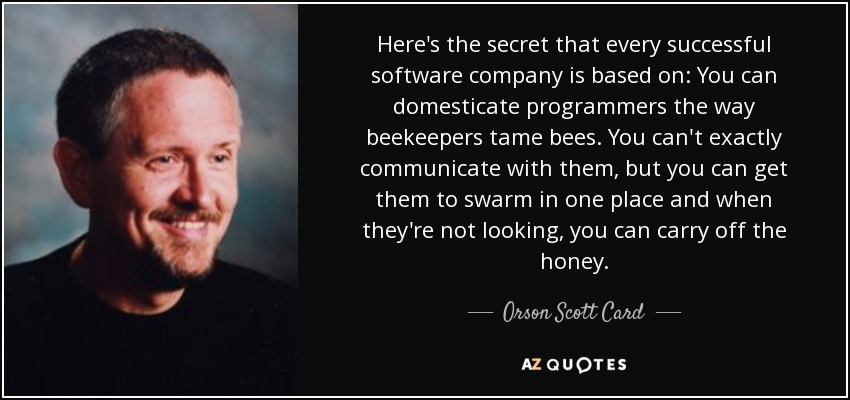
Here's the secret that every successful software company is based on: You can domesticate programmers the way beekeepers tame bees. You can't exactly communicate with them, but you can get them to swarm in one place and when they're not looking, you can carry off the honey.
Software is more important than hardware.
As a person with the retentive mental capacity of a goldfish and a dislike of repetition, I frequently make use of the thesaurus built into my Microsoft Word U.K. Software.
Microsoft has one more shot at a role in smart phone software through its deployment on Nokia phones. Nokia is still the global market share leader in cell phones. Maybe it will work out, but this is hard to envision great success in the area coming on the heels of so much disappointment in missed opportunity in this important and visible category.
I'm the founder of the McAfee Anti-Virus Software Company. Although I have had nothing to do with this company for over 15 years, I still get volumes of mail asking 'how do I uninstall this software'. I have no idea.
The current term of protection for software is the life of an author plus 70 years, or, if it's work-for-hire, a total of 95 years. This is a bastardization of the Constitution's requirement that copyright be for "limited times."
While the creative works from the 16th century can still be accessed and used by others, the data in some software programs from the 1990s is already inaccessible. Once a company that produces a certain product goes out of business, it has no simple way to uncover how its product encoded data. The code is thus lost, and the software is inaccessible. Knowledge has been destroyed.
The common thread for everything I do is this idea of a Web-services architecture. What does that mean? It means taking components of software and systems and having them be self-describing, so that you can aim them, ask them what their capabilities are, and communicate with them using a standard protocol.
Every young person gets so excited about new software packages and new technology.
Once GNU is written, everyone will be able to obtain good system software free, just like air.
Real software engineers don't debug programs, they verify correctness. This process doesn't necessarily involve execution of anything on a computer, except perhaps a Correctness Verification Aid package. Sex without love is an empty experience, but, as empty experiences go, it's one of the best.
I would say that hardware is the bone of the head, the skull. The semiconductor is the brain within the head. The software is the wisdom and data is the knowledge.
Everybody remembers numbers and computers remember numbers. People remember procedures and computers certainly remember procedures. But the other thing that's still important is that your perception as a human is affected subtly by all this stuff that you can't quite articulate. You run your life according to all this stuff that's happened to you. All of your memories affect everything you do whereas with a computer, there's adaptive software and things, but it's more literal.
Microsoft does not dominate the software industry by any stretch of the imagination. We have lots of very able competitors who keep us constantly vigilant, and sometimes they beat us to the punch. Microsoft's success to date is based solely on the fact that people like Microsoft software.
Frame is a good enough piece of software that there are actually rewards to taking an intelligent and formal approach to your problem. But if you want to be stupid, you can think of Frame as a version of Microsoft Word with most of the bugs taken out.
With software products, it is usual to find that the software has major `bugs' and does not work reliably for some users... The lay public, familiar with only a few incidents of software failure, may regard them as exceptions caused by exceptionally inept programmers. Those of us who are software professionals know better; the most competent programmers in the world cannot avoid such problems.
It's clear that other problems such as [...] the domination of business over government, science, thought, and society, are much bigger than non-free software.
I am confident that we can do better than GUIs because the basic problem with them (and with the Linux and Unix interfaces) is that they ask a human being to do things that we know experimentally humans cannot do well. The question I asked myself is, given everything we know about how the human mind works, could we design a computer and computer software so that we can work with the least confusion and greatest efficiency?
Software development takes immense intellectual effort. Even the best programmers can rarely sustain that level of effort for more than a few hours a day. Beyond that, they need to rest their brains a bit, which is why they always seem to be surfing the Internet or playing games when you barge in on them.
Just the attempt to learn a [new] language is like running different software through the brain.
Like any well designed software product, Windows is designed, developed and tested as an integrated whole.
What we were doing was trying to simply get the information we need once we learned from our vendor after the software glitch occurred that there had been a breach by the Sanders campaign staff, which I was glad to see senator [Bernie] Sanders acknowledge that was wrong and apologize for.
[We in Microsoft] are not the only software company but we are a great software company doing some unique work.
Now companies tend to mine gigantic databases for insights into what might happen six months from now. That might always be valuable, but there's a different kind of value - and a competitive edge - in processing ongoing streams of data through a software model that can quickly and constantly make predictions about, say, whether a certain customer is going to defect, or an aircraft is going to run into trouble.
Probably the biggest mistake that I made personally is I knew early on that I wanted to go into start-ups and creating kind of software that could help change the lives of millions of people. And basically what I did is I kind of went, okay, well, I need a set of titles and I need a checklist of skills, and I ran through all that, and that wasn't a useless thing, but what I didn't realize, and, you know, and no one gave me the right advice for doing this, is that actually your network, in essentially, is your career.
Follow AzQuotes on Facebook, Twitter and Google+. Every day we present the best quotes! Improve yourself, find your inspiration, share with friends
or simply: