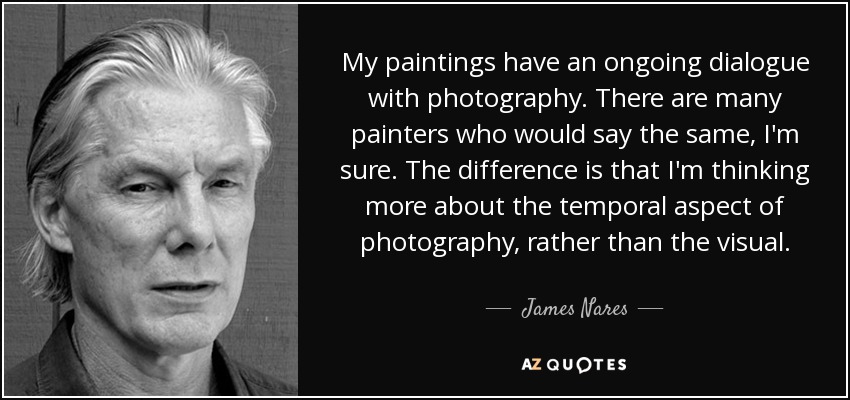
My paintings have an ongoing dialogue with photography. There are many painters who would say the same, I'm sure. The difference is that I'm thinking more about the temporal aspect of photography, rather than the visual.
Through a process of trial and error and experimentation, I discovered the simplest method - using only black - produced work with the strongest visual impact installed.
When Bill Gates started Corbis we were told that he needed images to fill those digital picture frames in his home, and many found this plausible. But now it's pretty clear that he's set out to control the visual history of the twentieth century.
To me, photography is not just a visual art, but something closer to poetry - or at least to some poetry, such as the haiku.
A lot of people in the art world hate to use the word "Photoshop", like it's cheating or easy or something. I say bollocks to that - for me, it's my tool, my paintbrush if you like, and lets me create my own visual language.
Though infested with many bewildering anomalies, photographs are considered our best arbiters between our visual perceptions and the memory of them. It is not only their apparent 'objectivity' that grants photographs their high status in this regard, but our belief that in them, fugitive sensation has been laid to rest.
Illusions as bad as mine make people aware of the fallacies of visual information and the pleasure to be derived from such fallacies.
The postmodernist critique of representation undermines the referential status of visual imagery, its claim to represent reality as it really is - either the appearance of things or some ideal order behind or beyond appearance.
[My photography teacher] gave me the Mexican Day Books of Edward Weston and just blew me away with this work. The fact that you could be this fabulous visual artist, with all this milieu of people like Diego Rivera and you could sleep with these gorgeous, amazing women, that you could live that life - that photography could deliver you that life.
It sometimes happens that you just know... You have a feeling that things are coinciding, and that they operate and work on a number of levels - obviously visual aesthetics, but also content and narrative in terms of the bigger picture. When document and metaphor come together.
Racism is a visual pathology.
Photojournalist? With a few exceptions, those of us working as photojournalists might now more appropriately call ourselves illustrators. For, unlike real reporters, whose job it is to document what's going down, most of us go out in the world expecting to give form to the magazine, or to newspaper editor's ideas, using what's become over the years a pretty standardized visual language. So we search for what is instantly recognizable, supportive of the text, easiest to digest, or most marketable - more mundane realities be damned.
The decisive moment, the popular Henri Cartier-Bresson approach to photography in which a scene is stopped and depicted at a certain point of high visual drama, is now possible to achieve at any time. One's photographs, years later, may be retroactively rephotographed by repositioning the photographer or the subject of the photograph, or by adding elements that were never there before but now are made to exist concurrently in a newly elastic sense of space and time.
Generally, the imagery and the text go hand in hand. It's much easier when the text comes first, but sometimes I need visual stimulation in order to find the words. I get an idea of what I want when I begin to shoot, and the text is usually the last thing to be resolved. I tend to leave the text open, and I refine the words up to the last minute. As for the image, I can resolve that and get that done fairly quickly.
The visual system of the brain has the organization, computational profile, and architecture it has in order to facilitate the organism's thriving at the four Fs: feeding fleeing, fighting, and reproduction.
Simplicity is all. Simple logic, simple arguments, simple visual images. If you can't reduce your argument to a few crisp words and phrases, there's something wrong with your argument. There's nothing long-winded about 'Liberté, égalité, fraternité'.
What you can do with visual effects is enhance the look of the character, but the actual integrity of the emotional performance and the way the character's facial expressions work, that is what is going to be created on the day with other actors and the director.
Music is a spiritual doorway its power comes from the fact that it plugs directly into the soul, unlike a lot of visual art or textual information that has to go through the more filtering processes of the brain.
What we need is a critique of visual culture that is alert to the power of images for good and evil and that is capable of discriminating the variety and historical specificity of their uses.
I was very young, maybe five. The opera was very... I was attracted to opera to the point that I think it's the reason I started to write music for films. I never studied. There are film and music school that teach you how to write music. I never studied that. But the influence of opera, which is a combination of storyline, visuals, staging, plus music... that was perhaps the best school I could have had. That's what gave me the idea of coming to Hollywood to write music for films.
Maybe there is a sort of a sweet middle ground there, where you can do something with something with like 20 to 40 million and do something which is much more character driven, but still create a sort of visual spectacle around it. That is what I'd like to do.
The visual side of being a performer or in a band is, to me, as important as the music. I know not everyone shares that same opinion, but when I'm writing songs or working on lyrics or coming up with an idea, I think about videos as I'm in the studio. If I had all the money in the world, I would have the most amazing videos ever, you know? You're saying grandiose, and big; if the song warrants it, I try to push the visuals as far as I can.
One of the more distant concerns is with the visual interpretation of the music. I find it fascinating but I don't always particularly get involved with it.
The idea of using media for expressing yourself artistically is kind of something I learned from my mother and my father. So for me, I think growing up wanting to be an artist, I always imagined myself sort of crossing over or mixing media and so it was a natural evolution for me to try to express in a filmic way or in a visual way. It just kind of seems like a natural sort of progression for me in terms of what I'm trying to do as an artist.
I love working with actors. I love visual things. I always intended to be a writer who directs and a director who writes.
Follow AzQuotes on Facebook, Twitter and Google+. Every day we present the best quotes! Improve yourself, find your inspiration, share with friends
or simply: