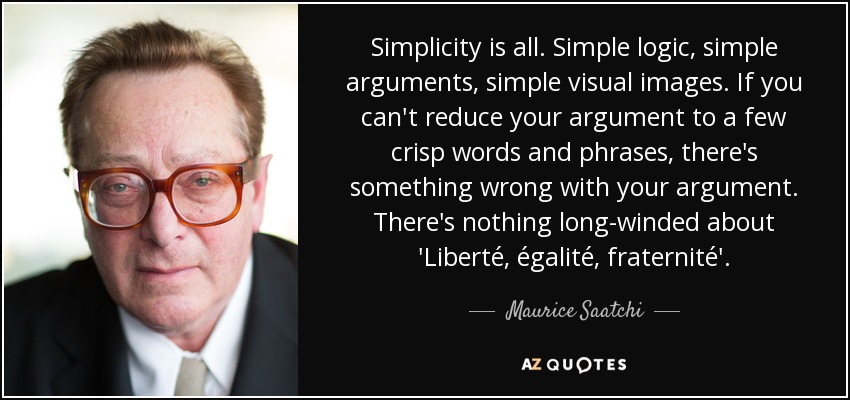
Simplicity is all. Simple logic, simple arguments, simple visual images. If you can't reduce your argument to a few crisp words and phrases, there's something wrong with your argument. There's nothing long-winded about 'Liberté, égalité, fraternité'.
What you can do with visual effects is enhance the look of the character, but the actual integrity of the emotional performance and the way the character's facial expressions work, that is what is going to be created on the day with other actors and the director.
Music is a spiritual doorway its power comes from the fact that it plugs directly into the soul, unlike a lot of visual art or textual information that has to go through the more filtering processes of the brain.
What we need is a critique of visual culture that is alert to the power of images for good and evil and that is capable of discriminating the variety and historical specificity of their uses.
I was very young, maybe five. The opera was very... I was attracted to opera to the point that I think it's the reason I started to write music for films. I never studied. There are film and music school that teach you how to write music. I never studied that. But the influence of opera, which is a combination of storyline, visuals, staging, plus music... that was perhaps the best school I could have had. That's what gave me the idea of coming to Hollywood to write music for films.
Maybe there is a sort of a sweet middle ground there, where you can do something with something with like 20 to 40 million and do something which is much more character driven, but still create a sort of visual spectacle around it. That is what I'd like to do.
The visual side of being a performer or in a band is, to me, as important as the music. I know not everyone shares that same opinion, but when I'm writing songs or working on lyrics or coming up with an idea, I think about videos as I'm in the studio. If I had all the money in the world, I would have the most amazing videos ever, you know? You're saying grandiose, and big; if the song warrants it, I try to push the visuals as far as I can.
One of the more distant concerns is with the visual interpretation of the music. I find it fascinating but I don't always particularly get involved with it.
The idea of using media for expressing yourself artistically is kind of something I learned from my mother and my father. So for me, I think growing up wanting to be an artist, I always imagined myself sort of crossing over or mixing media and so it was a natural evolution for me to try to express in a filmic way or in a visual way. It just kind of seems like a natural sort of progression for me in terms of what I'm trying to do as an artist.
I love working with actors. I love visual things. I always intended to be a writer who directs and a director who writes.
There's another aspect about the Seventies. Blazing Saddles, as wonderful as it was, sort of hurt the Western. It made such fun of them, that you almost couldn't take them seriously from that point on. That's why only Westerns that had the stink of Watergate or Vietnam could be taken seriously. There were so few Westerns made since then, from the Eighties on, that the few directors who did were so pleased with themselves and so happy to have the opportunity that they got lost in visuals, they got lost in the vistas and the pretty scenery.
Our knowledge of shape and form remains, in general, a mixture of visual and of tactile experiences... A child learns about roundness from handling a ball far more than from looking at it.
Taste tends to develop very unevenly. It's rare that the same person has good visual taste and good taste in people and taste in ideas.
It is difficult to say why I decided I wanted to be an artist. Obviously, I had some facility, more than other people, but sometimes facility comes because one is more interested in looking at things, examining them, more interested in the visual world than other people are.
The difficulty with color is to go beyond the fact that it's color ? to have it be not just a colorful picture but really be a picture about something. It's difficult. So often color gets caught up in color, and it becomes merly decorative. Some photographers use it brilliantly to make visual statements combining color and content; otherwise it is empty.
Develop your visual memory. Draw everything you have drawn from the model from memory as well.
Because it's visual art, a lot of it comes from childhood experience but then a lot comes from the visual language - in advertising and stuff like that - which is around us.
Commercials are so contemporary and up to date that when you're involved in that visual world, you can't really go backwards.
The popular eye is not untrained; it is only wrongly trained - trained by inferior and insincere visual representations.
Every act is a visual judgement.
I use visual perception as a way of bringing people into my space.
The paradox in the evolution of French painting from Courbet to Cezanne is how it was brought to the verge of abstraction in and by its very effort to transcribe visual appearance with ever greater fidelity.
It's as though aesthetic value, quality, could be preserved only by concentrating on 'absolute' or 'autonomous' art: thus on visual art... that held and moved and stirred the beholder as sheer decoration could not.
The different aspects of my activity, whether it's writing criticism, or doing visual work that incorporates writing, or teaching, or curating, is all of a single cloth, and I don't make any separation in terms of those practices.
The system is the work of art; the visual work of art is the proof of the System. The visual aspect can't be understood without understanding the system. It isn't what it looks like but what it is that is of basic importance.
Follow AzQuotes on Facebook, Twitter and Google+. Every day we present the best quotes! Improve yourself, find your inspiration, share with friends
or simply: