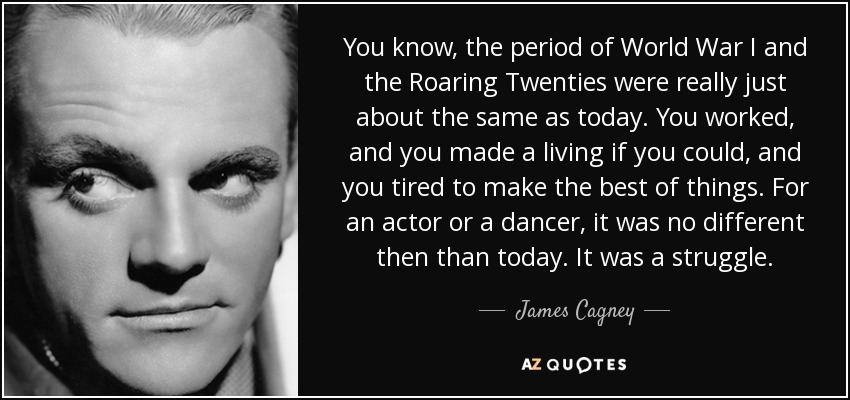
You know, the period of World War I and the Roaring Twenties were really just about the same as today. You worked, and you made a living if you could, and you tired to make the best of things. For an actor or a dancer, it was no different then than today. It was a struggle.
Of course, I also attribute some of my hearing loss to being in the infantry in World War II. It's probably a combination of heredity and noise exposure.
The only way to win World War III is to prevent it.
Long before there was discrimination against blacks, there was discrimination against white southerners. When large numbers of these country people moved north during World War II, they were aggressively excluded from neighborhoods, jobs, and homes - not because of their skin color, but their accents.
I actually love history. I've devoured book after book of stories from World War I and World War II. They're really two sections of world history that really interest me.
My wife was my greatest asset. I didn't marry her until after World War II, but she has complemented me in every job I've ever had
Between 1965 (the beginning of LBJ's "Great Society") and 1994, welfare spending has cost the taxpayers $5.4 trillion in constant 1993 dollars. The War on Poverty has cost us 70 % more than the total price tag for defeating both Germany and Japan in World War II, after adjusting for inflation. Many believe that Welfare has destroyed millions of families and cost a huge portion of our national wealth in the process.
The history of those who shed those other tears, the history of those anonymous millions, is what Terkel wants readers and listeners to come away with. What's it like to be that goofy little soldier, scared stiff, with his bayonet aimed at Christ? What's it like to have been a woman in a defense-plant job during World War II? What's it like to be a kid at the front lines? It's all funny and tragic at the same time.
There never was a good war or a bad revolution.
The attitude of the American public toward the external projection of American power has been much more ambivalent. The public supported America's engagement in World War II largely because of the shock effect of the Japanese attack on Pearl Harbor.
All the other books ask, 'What's it like?' What was World War II like for the young kid at Normandy, or what is work like for a woman having a job for the first time in her life? What's it like to be black or white?
We need to get insurance out of the way and let the consumer interact with their doctor the way they did basically before World War II.
I made a French film called "Merry Christmas" which is a very European film. It's a World War I piece.
Every constitution written since the end of World War II includes a provision that men and women are citizens of equal stature. Ours does not.
I realized how for all of us who came of age in the late sixties and early seventies the war was a defining experience. You went o r you didn't, but the fact of it and the decisions it forced us to make marked us for the rest of our lives, just as the depression and World War II had marked my parents.
There will be no veterans of World War III.
They said it was against the rules to take sides on a controversial issue. I said, 'I wish you had told me that during World War II, when I took sides against Hitler.
The notion of a neutral, mainstream national media gained dominance only in World War II and in its aftermath, when what turned out to be a temporary moderate consensus came to govern the country.
The U.S. has since the end of World War II had an answer - we stand for free peoples and free markets, we are willing to support and defend them - we will sustain a balance of power that favors freedom.
War on terror' is a misnomer. It would be like calling America's involvement in World War II a 'war on kamikazism.' Terrorism, like kamikazism, is a tactic.
No one is immune from the larger events of his or her time - the Depression, World War II, civil rights, Vietnam, the spring of 1989 in China. These events intrude upon our lives and radically affect our directions.
"World War III, was the Cold War, and the U.S. won it".
"World War III, was the Cold War".
I think this conflict [against terrorism] is going to require a suspension of freedom and rights unlike anything we have ever seen, at least since World War II.
If you were born in Britain after World War II, you see a continuous atmosphere of decline, moral and economic and political.
Follow AzQuotes on Facebook, Twitter and Google+. Every day we present the best quotes! Improve yourself, find your inspiration, share with friends
or simply: