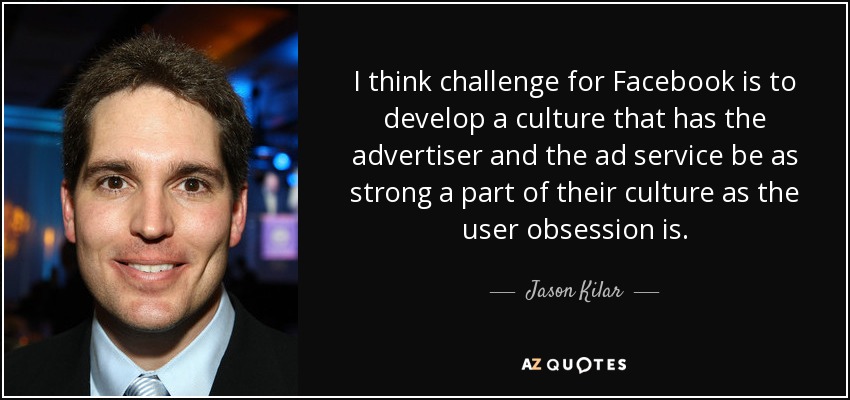
I think challenge for Facebook is to develop a culture that has the advertiser and the ad service be as strong a part of their culture as the user obsession is.
I think that overall, ultimately the impact of advertisers calling the shots is a more cloying, complacent culture. For example, it was just announced that Unilever is branding environmental content at The Guardian. How radical or pointed can that content be?
It's a growing trend. Viewers are our customers, but so are advertisers. And advertisers want different ways to reach our viewers.
Ultimately, broadcasters and advertisers have to change the way they do business or they run the risk of linear TV becoming obsolete.
Not literature alone, but society itself is wormed and rotten when language ceases to be respected not merely by advertisers and politicians, but by persons of learning and authority.
There is critical mass with high-speed Internet connections, so video is a good user experience. And that means there can be critical mass for advertisers.
That something extra, I believe, is a certain humanity that comes from upbeat and positive human interest letters and success stories. Advertisers like to be associated with those qualities.
They are obviously pirate services. Sure they might be able to survive as small businesses, but it's hard to get advertisers to advertise on a pirate site. It's a hugely fragmented market.
Whether you are buying a car or casting a ballot, choosing a job or planning a family, follow your moral compass. Don't let others define you. Don't let advertisers mold you; don't let zealots ensnare you; don't let conventional wisdom trap you....you are part of a much larger whole.
Movies, far more than the traditional arts, are tied to big money. Without a few independent critics, there's nothing between the public and the advertisers.
It's nice that HBO is in business with the audience and not with the advertisers. There's a difference.
It takes uncommon guts to stick to one style in the face of all the pressures to 'come up with something new' every six months. It is tragically easy to be stampeded into change. But golden rewards await the advertiser who has the brains to create a coherent image, and the stability to stick with it over a long period.
Advertisers regularly con us into believing that we genuinely need one luxury after another. We are convinced that we must keep up with or even go one better than our neighbors. So we buy another dress, sports jacket or sports car and thereby force up the standard of living. The ever more affluent standard of living is the god of twentieth century North America and the adman is its prophet.
Even one's own home is a kind of anthology of advertisers, manufacturers, motifs and presentation techniques. There's nothing 'natural' about one's home these days. The furnishings, the fabrics, the furniture, the appliances, the TV, and all the electronic equipment - we're living inside commercials.
The general advertisers and their agencies know almost nothing for sure, because they cannot measure the results of their advertising. They worship at the altar of creativity, which really means 'originality': The most dangerous word in the lexicon of advertising
American advertisers rely on 'essentially illogical' approaches to determine their advertising budgets.
Removed from 'Gmail' doesn't necessarily mean removed from all Google servers. In fact, your old emails are the data set from which Google models our behaviors - the real product it is offering its advertisers.
Open source is a beautiful way of collaborating; but what's happening on the free Internet is more akin to the 'crowdsourcing' of journalists and other content creators by advertisers who no longer have to pay them - only the search engines that parse their articles.
In spite of my own reservations about Bing's ability to convert Google users, I have to admit that the search engine does offer a genuine alternative to Google-style browsing, a more coherently organized selection of links, and a more advertiser-friendly environment through which to sell space and links.
We are extremely proud to represent all of Radio One's stations within the Katz Radio Group. For the past five years we have worked diligently alongside Radio One to build their business in the markets we have historically represented including Houston, Los Angeles, Philadelphia , Raleigh and Columbus. At a time of significant growth in the African American consumer market the addition of the remaining Radio One stations expands our ability to deliver strategic marketing solutions to our agency and advertiser customers.
Advertisers are very wary of ideological media.
TiVo and other digital recording devices have confounded advertisers. The ad industry sees the technology as a threat to their product.
Starbucks is not an advertiser; people think we are a great marketing company, but in fact we spend very little money on marketing and more money on training our people than advertising.
The theme of corporate stories (and millions drink them in every day) seldom varies: to be happy you must consume, to be special you must conform. Absurd, obviously, yet our identities have become so fragile, so elusive, that we seem content to let advertisers provide us with their version of who we are, to let them recreate us in their image: a cookie-cutter image based on market research, shallow sociology, and insidious lies.
The more broadband we can get globally, the better. It's better for the world; it's better for our advertisers; it's better for Google.
Follow AzQuotes on Facebook, Twitter and Google+. Every day we present the best quotes! Improve yourself, find your inspiration, share with friends
or simply: