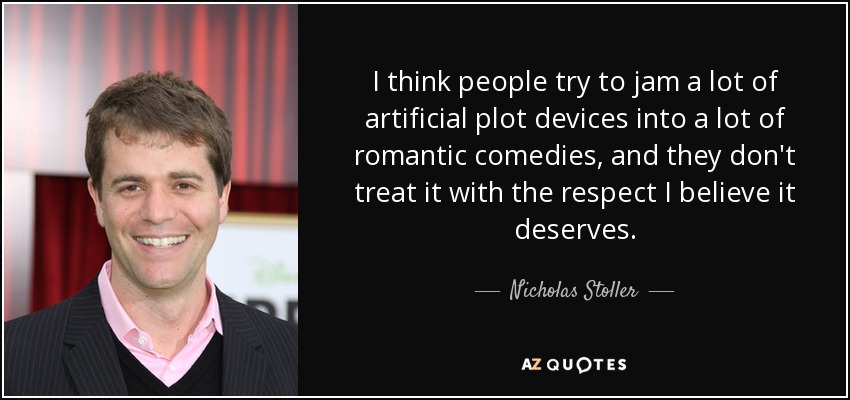
I think people try to jam a lot of artificial plot devices into a lot of romantic comedies, and they don't treat it with the respect I believe it deserves.
You learn to do your best writing on story rather than off story. Very often at the beginning of their careers, writers including me do their best dialogue writing off story - the best lines, the best observations - but they haven't got enough to do with the plot to stay in.
My husband makes fun of me, because I know I can use strong prose to jazz-hand my way through plot that isn't as interesting as I'd like it to be.
I believe the only way a writer can keep himself up to the mark is by examining each story quite coldly before he starts writing it and asking himself if it is all right as a story. I mean, once you go saying to yourself, 'This is a pretty weak plot as it stands, but I'm such a hell of a writer that my magic touch will make it okay,' you're sunk. If they aren't in interesting situations, characters can't be major characters, not even if you have the rest of the troop talk their heads off about them.
My major contribution to the format was to suggest that I be able to step out of the plot and speak directly to the audience, and then be able to go right back into the action. That was an original idea of mine; I know it was because I originally stole it from Thornton Wilder's play Our Town.
Plot involves fragmentary reality, and it might involve composite reality. Fragmentary reality is the view of the individual. Composite reality is the community or state view. Fragmentary reality is always set against composite reality. Virginia Woolf did this by creating fragmentary monologues and for a while this was all the rage in literature. She was a genius. In the hands of the merely talented it came off like gibberish.
Resolution and conclusion are inherent in a plot-driven narrative.
The absence of plot leaves the reader room to think about other things.
With relatively few exceptions, the novel sacrifices too much, for me, on the altar of plot.
Plots are for dead people.
Let's be clear: all professions look bad in the movies. And there's a good reason for this. Movies don't portray career paths, they conscript interesting lifestyles to serve a plot. So lawyers are all unscrupulous and doctors are all uncaring. Psychiatrists are all crazy, and politicians are all corrupt. All cops are psychopaths, and all businessmen are crooks. Even moviemakers come off badly: directors are megalomaniacs, actors are spoiled brats. Since all occupations are portrayed negatively, why expect scientists to be treated differently?
When I was writing Dune there was no room in my mind for concerns about the book's success or failure. I was concerned only with the writing. Six years of research had preceded the day I sat down to put the story together, and the interweaving of the many plot layers I had planned required a degree of concentration I had never before experienced.
This is all thousands of years old. It's the same the world over. Anyone who has ever walked upright has loved beer, celebrated over it, told talks over it, hatched plots over it, courted over it. It's what we do as a species. It's what makes us human. We brew.
You compare yourself to somebody who you think is a peer, and you can totally lose the plot, and not understand that you are nothing like them in the first place, and it was never you versus anybody.
Anything that happens on any show is a plot contrivance because that's just storytelling.
Mockumentary formats are great for a couple of things. One of them is delivering the toughest part of any sitcom episode, what writers call "pipe" - the nuts and bolts of the story where you explain what's happening, the boring plot stuff.
Growing up, for years and years I had no idea what the plots of operas were, and that's part of what fascinated me - I could make them up and learn bits and pieces of what was going on over time. There's something about it being always a step away that makes it more fun to chase.
[Gertrude Stein] really needed someone like Virgil Thomson, whom she respected, to sit on her a bit and make her devise some plot.
I seem to wonder if we can reach some kind of new destination with cinema, or touch upon human existence in a different way to what cinema usually does in its very schematic and sometimes very controlled, plot-oriented ways of thinking. Sometimes I feel like I've found the holy grail, and next week I think it's a complete mistake and I need to try something completely different. It's an ongoing process.
Each piece of dialogue MUST be "something happening". . .The "amusing" for its OWN sake should above all be censored. . .The functional use of dialogue for the plot must be the first thing in the writer's mind. Where functional usefulness cannot be established, dialogue must be left out.
The Christian faith is the most exciting drama that ever staggered the imagination of man-and the dogma is the drama ... The plot pivots upon a single character, and the whole action is the answer to a single central problem: 'What think ye of Christ?'... He was emphatically not a dull m an in his human lifetime, and if he was God, there can be nothing dull about God either.
When you are drawing characters to serve a plot purpose, you tend to get flat, stereotyped, unliving characters.
In the years since The Life and Extraordinary Adventures of Private Ivan Chonkin, Voinovich has sharpened his satire, and Monumental Propaganda is a novel that slashes and rips -- but not on every page. He expands his narrative to accommodate shrewd philosophy and inventive portraiture, a very amusing disquisition on Soviet latrines and a number of outlandish plot developments. In his translation, Andrew Bromfield deftly shifts his tone and tools as required, remaining true to Voinovich's Vonnegut-like playfulness and appreciation of the absurd.
The families of rabbits or woodchucks will eat the salad greens just before they are ready to be picked; I plot ways to kill these animals but can never bring myself to do it.
I like the plot of The Nutcracker - not at all.
Follow AzQuotes on Facebook, Twitter and Google+. Every day we present the best quotes! Improve yourself, find your inspiration, share with friends
or simply: