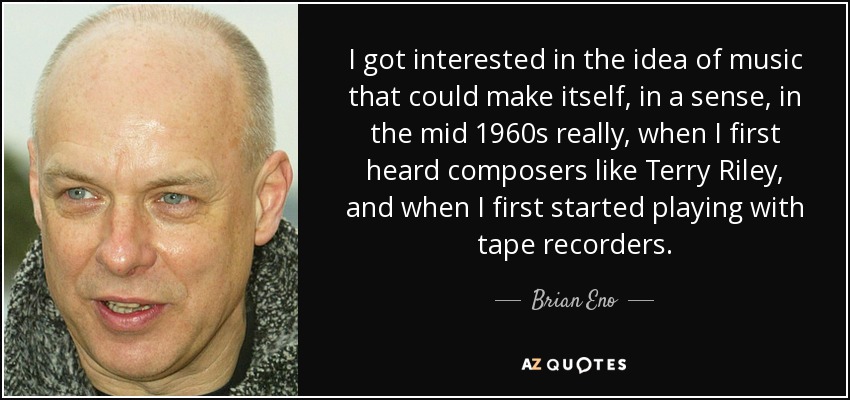
I got interested in the idea of music that could make itself, in a sense, in the mid 1960s really, when I first heard composers like Terry Riley, and when I first started playing with tape recorders.
If the black box flight recorder is never damaged during a plane crash, why isn’t the whole airplane made out of that stuff?
right' i said. 'but first, we need the car. and after that, the cocaine. and then the tape recorder, for special music, and some acapulco shirts.
I got a new 4-track cassette recorder a year or so after high school. For a while I would just stare at it thinking, how am I going to do this if I don't play guitar or keyboards? How am I going to write and record a song if I don't know how to play any instruments? I mean, I played the violin, but I didn't know anything about how to work a 4-track.
It is just like your tape-recorder. It records, it reproduces - all by itself. You only listen. Similarly, I watch all that happens, including my talking to you. It is not me who talks, the words appear in my mind and then I hear them said.
I used to do little sketches into my cassette tape recorder when I was a little boy. I would just turn it on and just start doing voices and characters. I just loved it.
When I give a speech at a corporate event, I often ask those in attendance, 'Do you know how to tell if you're doing the job?' As heads start whispering back and forth, I provide these clue: 'If you're up at 3 A.M. every night talking into a tape recorder and writing notes on scraps of paper, have a knot in your stomach and a rash on your skin, are losing sleep and losing touch with your wife and kids, have no appetite or sense of humor, and feel that everything might turn out wrong, then you're probably doing the job.'
To me, one of the greatest triumphs in doing a book is to tell the story as simply as possible. My aim is to imply rather than to overstate. Whenever the reader participates with his own interpretation, I feel that the book is much more successful. I write with the premise that less is more. Writing is not difficult to me. I read into a tape recorder, constantly dropping a word here and there from my manuscript until I get a minimum amount of words to say exactly what I want to say. Each time I drop a word or two, it brings me a sense of victory!
I think if you write humor, then people don't - you know - they don't give you that much credit. They tend to think you just dictate your stories into a tape recorder. And I'm not necessarily insulted by that, because I think that just means that it looks easy.
I approach writing stories as a recorder. I think of my role as some kind of reporting device - recording and projecting.
I think it's always hard for children to talk about abuse because it is only memory. I didn't carry around a tape recorder … I didn't chisel anything in stone … Anybody can look and say, 'Well how do you know for sure?' And that's one of the most painful things about it. You don't.
I'm here as a radio journalist but am not even sure which part of a tape recorder takes the pictures.
I wanted to get a tape recorder, but I got a parrot instead. I think I did that joke backwards.
I wanted to be a part of history and not just a recorder and teacher of history. So that kind of attitude towards history, history itself as a political act, has always informed my writing and my teaching.
I am constantly torn between the attitude of the conscientious journalist who is a recorder and interpreter of the facts and of the creative artist who often is necessarily at poetic odds with the literal facts.
I was 4 and dictating stories into a tape recorder, and my mom typed them up.
Many of my characters first came through to me as voices. That's why I use a tape recorder.
Today is a time of turbulence and stagnation, of threat and promise from a competitor: the magic, omnivorous videocassette recorder (VCR). In other words, it is business as usual.
In this 21st century, bedtime doesn't matter at all. All that matters is what you set for your DVR [Digital Video Recorder].
The beauty of having a studio is I can go in and record any time I want to, so you can always put down your ideas or whatever. You use your voice recorder and, you know, take your voice notes down and just preserve all the little jewels and gems when you're in there, putting that song together.
When I was a little kid I loved the Marx brothers and discovered Monty Python when I was 10 or 11-years-old. I used to take a tape recorder and hold it up in front of the TV to record entire episodes to play over and over again, so that I could memorise it.
Our whole dream for our home was for it to be an artist's haven. So there are paint supplies; there's a piano with a microphone and a recorder right there to capture things right in the second. There's editing equipment. There are cameras. I think the only thing in our house that people would be surprised by is the efficiency.
The experience of playing music at a young age really opens up one's mind to different melody in life itself, literally - like, when you've even played a recorder, or whatever, it becomes a lot easier to hear the beauty in a bird's song, or the quiet tune in a gentle rustle of the wind.
No medicine man these days can afford to be without a portable tape recorder. Without the aid of this modern device, which may be easily concealed in the undergrowth of the jungle, the old tribal authority will rapidly become undermined by the mounting influenece of modern skepticism.
I write to be recorder, observer, participant, and sometimes, even judge. I want to engage the world as I see it with my whole self - all of those different aspects of it.
Follow AzQuotes on Facebook, Twitter and Google+. Every day we present the best quotes! Improve yourself, find your inspiration, share with friends
or simply: