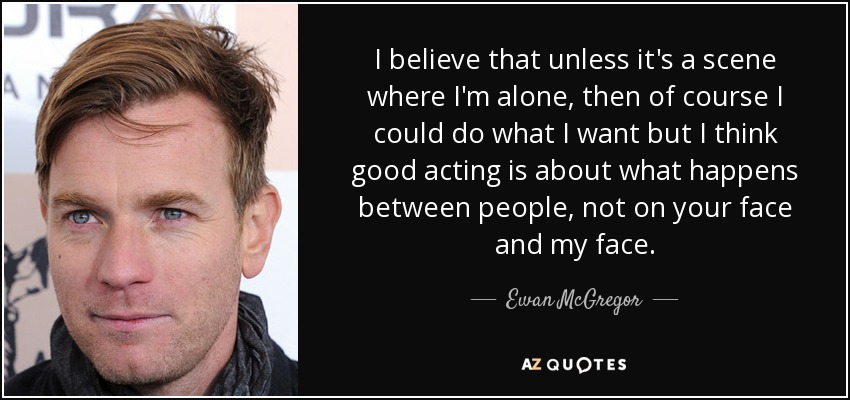
I believe that unless it's a scene where I'm alone, then of course I could do what I want but I think good acting is about what happens between people, not on your face and my face.
For the actors, there's something very important about that first showing of the scene to the crew, becomes like a little performance.
You would never dream of going on to play a scene in front of an audience at least without having rehearsed it. But you do somehow in front of a camera.
You know, an audition usually is you come in and read the scene and if you're lucky, you get to read it twice.
It's impossible to put your finger on what that is exactly other than protecting the environment that the actors get to find the scenes and build the scenes and invest in them. I think that's key and that's what I've learned from all the great directors I've worked with.
What is useful about when there is a sort of pull-out to reveal moment going on is that it actually focuses the mind when you're writing the earlier scenes because you're thinking 'right, how do I? I can only show this amount of the room... I can only show these characters from the waist up because they've all got robot legs!' it's a challenge so it keeps you engaged on some level.
[Tim White] always spoke about his work in terms of forensics, as if he was investigating a crime scene. While we were there, they found the fossilized excrement of a lion that had turned into stone, and we would immediately start to concoct stories. Was it a lion that killed the early human? Of course, the lion could've been there three weeks later, or maybe 20,000 years earlier.
For example, if it's a sad scene, I need to feel that way, at least to a slight degree and for a short while, to get it right. Which is why I sometimes listen to music when I'm revising. Music creates moods for me quicker than any other medium.
When I'm writing something, if it gets too serious, I just can't bear it, so I take a step back and take the overall scene in and vent the air a little bit.
The movie [Blue Jasmin] shot very quick. I met Cate Blanchett in the car on the way to set, and we did that last scene, and she was just so phenomenal. I had basically met her that day. Because the way he shoots, everybody just shows up and does their thing, and he moves us very quickly.
I had one line. My two larger scenes had gone fine, and then on that day I screwed up that line over and over and over again. And every time I screwed it up, they can't use the whole thing because they're only using the one shot [in Blue Jasmin]. That was my last day.
I had many dolls. And you know how I played with them? By performing insurrections, assemblies, scenes of arrest. My dolls were almost never babies to be nursed but men and women who attacked barracks and ended up in prison.
When we shot that [Westworld], it was so funny. Not funny - I mean, like, funny-strange because I, personally as an actress and as a person, am so used to having to play the damsel, that when we were shooting that scene, and Jimmi looked at me and said, "Dolores, run," I ran. Then I stopped myself, and I turned around and I went, "Oh my God. I'm so used to running."
Obviously record companies tend to be following what the scene is rather than making the scene.
Sometimes when you do fight scenes you think, "Oh, I'll be hit in the face," because people get carried away with their vanity and want to look too cool to care, but we were all really careful with each other.
In the texts, and as His Holiness the Dalai Lama reminds us, we should check the person's behavior not when they're sitting on a big throne, but behind the scenes. How do they treat ordinary people - not the big sponsors - but just ordinary people who are of no particular importance to them.
What I found was an emotional consistency with him. The words, the scenes, the situations - I wasn't mimicking what I thought Branch Rickey's emotional reality would have been.
We did every scene together, every day for four months, and it could have been a disaster, if we didn't get on, but we clicked straight away. Elijah Wood is just the nicest guy.
Sometimes I watch a scene I've written, and occasionally I think, "Oh, for God's sake, shut up."
I knew the basic outline of the novel [The Dissemblers] and would write whatever scene of the book I felt particularly excited about at the time.
At the end, I cobbled scenes all together and smoothed out the transitions as much as possible. Incidentally, I would not recommend this approach to writing a book, and will probably not write that way again!
It's hard to top what you see in the film, they were just such a great group of people to work with and we all hung out in between scenes and I got to know everybody a little bit.
We [ with Emilio Estevez] asked if we could take some things [ in Breakfast Club] that weren't in the shooting draft, but from earlier drafts, "Can we maybe use this?" And Hughes was very amenable to all that. And there was some stuff that I liked, and I said, "How about this?" And he went, "Well, we'll check with Molly [Ringwald]. Those scenes are with her. And if she likes it, fine." So it was just wonderful. It was great.
In movies, you just see somebody close their eyes, and you go on to the next scene.
What people think improvisation is and non-improvisation is, it's nothing to do with what you like or dislike. It's all about how it happens with certain directors and certain scenes. That's the way it works. It's not something, in general, that you can decide.
Follow AzQuotes on Facebook, Twitter and Google+. Every day we present the best quotes! Improve yourself, find your inspiration, share with friends
or simply: