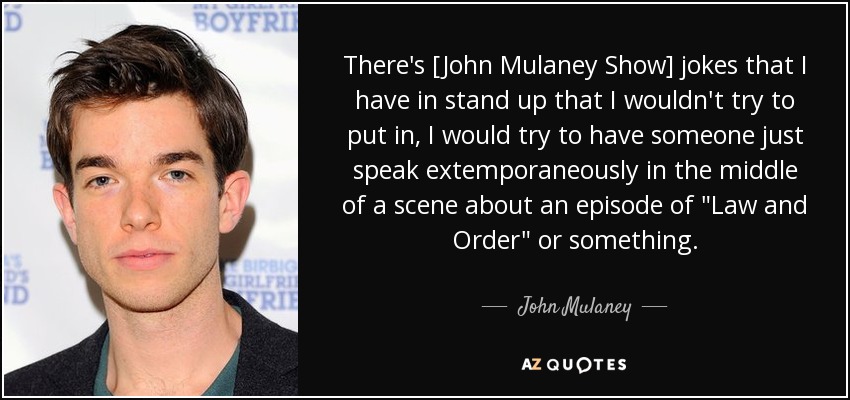
There's [John Mulaney Show] jokes that I have in stand up that I wouldn't try to put in, I would try to have someone just speak extemporaneously in the middle of a scene about an episode of "Law and Order" or something.
I have found myself deeply, deeply intrigued by the ska-punk scene. It's such an expressive form of popular music, it's so real, it's got so much life: it's the most vital music in the world.
Eleanor Roosevelt could easily have told negroes the deceitful maneuvering of the United States government that was going on behind the scenes. She never did it. In my opinion she was just another white woman whose profession was to make it appear that she was on the negro's side. You have a lot of whites who are in this category. Therefore, they have made negro loving a profession.
Any music star would be singing about his lost love. A movie would be about a relatable incident; it wasn't an untouchable magic dragon box. It was something that people could relate to, and when I vanished a girl, it would be a story about a girl that left me, or a cutting into pieces would be a date with a magician. I wouldn't just vanish a girl in a shower, I would do the shower scene from Psycho [1960] with a [Alfred] Hitchcock cameo.
Ahmadinejad is just a buffoon, sort of a clown on the international scene who tries to be provocative so he can get his name in the paper and his face on television.
I reject totally the characterization of a transwoman as a mutilated man. First, that formulation presumes that men born into that sex assignment are not mutilated. Second, it once again sets up the feminist as the prosecutor of trans people. If there is any mutilation going on in this scene, it is being done by the feminist police force who rejects the lived embodiment of transwomen. That very accusation is a form of "mutilation" as is all transphobic discourse such as these.
The experience of directing yourself in a sex scene is, in a way, great. It's the fantasy we all have in our lives all the time.
You gleefully say, "I just thought of something!", when in fact your brain performed an enormous amount of work before your moment of genius struck. When an idea is served up from behind the scenes, your neural circuitry has been working on it for hours or days or years, consolidating information and trying out new combinations. But you take credit without further wonderment at the vast, hidden machinery behind the scenes.
I was like, I can't believe I get to be in a scene with Meryl Streep [in Florence Foster Jenkins]! And then I was like, but why do I have to play Chopin? It's already going to be intimidating.
We played around and improvised a ton [in The Hangover], and I think it's hard to say at this point what's what. Gosh, I wouldn't even know how to take a stab at it. The script was so good that we really didn't need to improvise very much, but I think we just found a lot of moments on the set. It's really cool when you get onto the set of a movie and you start shooting the scenes and you start to actually incorporate the environment.
I'm working on a script right about Civil War re-enactors who go back in time to the actual Civil War. It's kind of a big, crazy Back to the Future comedy. So, of course, it's the Civil War - I play the banjo. I was just having a conversation with one of the producers about some of the material and he was like, 'You know, we have to work in a scene where you play the banjo. And I was like I'll get behind that.
This s - t [smoked on scenes] called Wizard Smoke. I didn't like it. [James] Franco didn't have that hard of a time with it. Franco will smoke anything.
I don't think that any scene [in Pineapple Express] is word for word how you'd find it in the script. Some of it was much more loose than others. The last scene with me, Danny [McBride] and James [Franko] in the diner - there was never even a script for that scene. Usually we write something, but for that scene we literally wrote nothing.
All I really know in nonfiction is that when I come home, I've got all these notes and I'm trying to figure out what actually happened to me. I usually kind of know what happened, but as you work through the notes, you find that certain scenes write well and some don't even though they should. Those make a constellation of meaning that weirdly ends up telling you what you just went through. It's a slightly different process, but still there's mystery because when you're bearing down on the scenes, sometimes you find out they mean something different than what you thought.
When you shoot a scene, you remember every moment. You remember when your head went down, your head went up. You don't see little quirks, little eye movements, little lip movements. Once again, you become completely vain when you're watching it in a way that you weren't when you were shooting it. And the vanity, what it makes you focus on are everything that has nothing to do with the scene and everything to do with your own ego.
Every time I would say put a baby in every scene.
Companies whose marketing and sales departments are not using the Internet and social media for communication may have the same fate that the dime stores had when Wal-Mart came onto the scene.
When your blood is found at the murder scene, that's the end of the ball game, there's nothing more to say.
I love the resource of the Internet. I use it all the time. Anything I'm writing - for example, if I'm writing a scene about Washington D.C. and I want to know where this monument is, I can find it right away, I can get a picture of the monument, it just makes your life so much easier, especially if you're writing fiction. You can check stuff so much quicker, and I think that's all great for writers.
It's untrue to say the colors I use are not those of reality. They are real: The red I use is red; the green, green; blue, blue; and yellow, yellow. It's a matter of arranging them differently from the way I find them, but they are always real colors. So it's not true that when I tint a road or a wall, they become unreal. They stay real, though colored differently for my scene.
The script is a starting point, not a fixed highway. I must look through the camera to see if what I've written on the page is right or not. In the script, you describe imagined scenes, but it's all suspended in mid-air. Often, an actor viewed against a wall or a landscape, or seen through a window, is much more eloquent than the lines you've given him. So then you take out the lines. This happens often to me and I end up saying what I want with a movement or a gesture.
I've always played down the drama in my films. In my main scenes, there's never an opportunity for an actor to let go of everything he's got inside. I always try to tone down the acting, because my stories demand it, to the point where I might change a script so that an actor has no opportunity to come out well.
My films have always had an element of immediate autobiography, in that I shoot any particular scene according to the mood I'm in that day, according to the little daily experiences I've had and am having - but I don't tell what has happened to me. I would like to do something more strictly autobiographical, but perhaps I never will, because it isn't interesting enough.
The trouble with normal is it always gets worse, fashionable fascism dominates the scene.
The Clintons are obsessed with money, and they have been since they came on the national scene. I'm sure that both of them since childhood have been obsessed with money. And I mean it. I mean obsessed with not having it when they were young.
Follow AzQuotes on Facebook, Twitter and Google+. Every day we present the best quotes! Improve yourself, find your inspiration, share with friends
or simply: