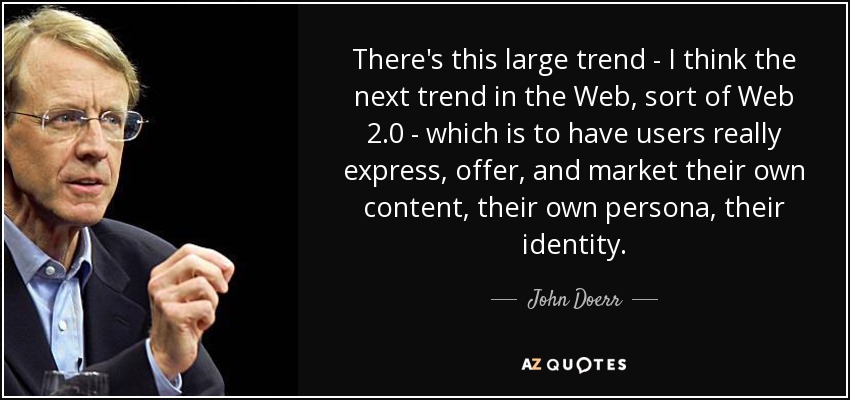
There's this large trend - I think the next trend in the Web, sort of Web 2.0 - which is to have users really express, offer, and market their own content, their own persona, their identity.
I think it's pretty obvious to most people that Napster is not media specific, but I could see a system like Napster evolving into something that allows users to locate and retrieve different types of data other than just MP3s or audio files.
It would be wrong to say that the city of Berlin is not regulated. What I think is more interesting is to what extent a city creates a sort of safe haven for its users, so that people feel confident that the city works on their behalf.
The primary duty of an exception handler is to get the error out of the lap of the programmer and into the surprised face of the user. Provided you keep this cardinal rule in mind, you can't go far wrong.
Even if it was a difficult operation to copy a song, it only takes one person to do it. After that the spread of the song via the Internet or other means of propagation is only limited by the honesty of the users.
You need to look no further than Apple's iPhone to see how fast brilliantly written software presented on a beautifully designed device with a spectacular user interface will throw all the accepted notions about pricing, billing platforms and brand loyalty right out the window.
Hulu is about the shows, not the networks. The shows are the brands that users care about.
It's fantastic to be known as a company that responds quickly to users, shares great resources and friendly banter with them over Twitter, and forges relationships on Pinterest, Facebook, and every other social media site out there.
Keeping a 'CEO blog' or 'founder's blog' can be a great platform for engaging your users in a nontraditional way, reaching people outside of your product pitch and building rapport without selling them anything except a belief in your ideas.
Think of Slide as a giant media network for people to transmit information. The content that's in there now has been provided by users - it's whatever they want it to be.
What happens to the Microsofts, Oracles and IBMs of the world is that when they get big enough, they don't think they need to bring that same level of focus and energy to the end-user experience.
I think Facebook's biggest problem is the glut of information that Facebook's power users are overwhelmed with.
25 percent of search results for the world's top 20 largest brands are links to user-generated content. 34 percent of bloggers post opinions about products and brands.
Because of the way tech is changing, and becoming cheaper and user-friendly, it's becoming easier to make films cheaply, maintaining quality.
To devise an information processing system capable of getting along on its own - it must handle its own problems of programming, bookkeeping, communication and coordination with its users. It must appear to its users as a single, integrated personality.
In a wristwatch, imagine the battery is in the strap and there's a medical sensor in there connected to the internet. If someone is monitoring that, they could phone up if the user has forgotten to take some medication. This could save hundreds of dollars in medical fees later. What's missing? It's a stable battery.
People might start with LiveJournal or Blogger, but if they get serious, they'll graduate to WordPress. We try to cater to the more powerful users.
The biggest challenge for open source is that as it enters the consumer market, as projects like WordPress and Firefox have done, you have to create a user experience that is on par or better than the proprietary alternatives.
We weren’t trying to strike it rich with Firefox. It’s open source and it’s free. We weren’t trying to take over the world; we had kind of modest goals, and it was OK if it failed. We were a lot freer to make risky decisions. If you can afford to do things that way, it’s just so much better. You’re not thinking about venture capitalists or marketing or sales. Just product and users, all day every day.
I have discovered that there are two types of command interfaces in the world of computing: good interfaces and user interfaces.
I took a job in the U.S. because I wanted to work on products that would get into end users' hands. In Norway, most of the jobs are in server software, niche stuff.
The thing about startups is you can make it, and if it's wrong you can remake it, and you can build a team that you want to have, a product that you want to have. You're utterly focused on your users or your customers and their needs, and trying to figure out how to meet those needs.
Babelgum has no ties to individual content owners and distributors, and as a result our editorial strategy is primarily 'user-centric.' That strategy ensures the platform satisfies the needs of a potentially infinite number of niche audiences around the world.
I think that building any product that has a lot of user loyalty is a bit like making a sequel to a great movie or video game - people generally want 'more of the same thing, except better and different.
I'm not looking to step in and make 'big, bold changes' - I think reddit is great, and the team has a lot of good features already in the pipeline to improve functionality for users and mods, help with subreddit discovery, improve the API, and help bring reddit to more people.
Follow AzQuotes on Facebook, Twitter and Google+. Every day we present the best quotes! Improve yourself, find your inspiration, share with friends
or simply: