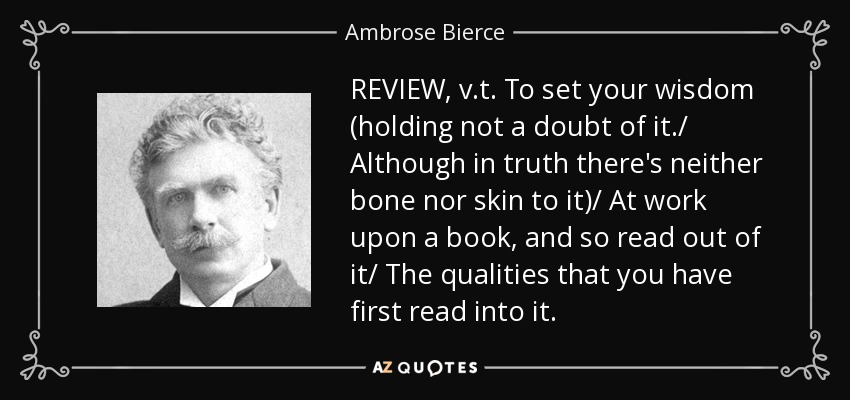

REVIEW, v.t. To set your wisdom (holding not a doubt of it./ Although in truth there's neither bone nor skin to it)/ At work upon a book, and so read out of it/ The qualities that you have first read into it.
PHILISTINE, n. One whose mind is the creature of its environment, following the fashion in thought, feeling and sentiment. He is sometimes learned, frequently prosperous, commonly clean and always solemn.
Immoral: Inexpedient. Whatever in the long run and with regard to the greater number of instances men find to be generally inexpedient comes to be considered wrong, wicked, immoral. If mans notions of right and wrong have any other basis than this of expediency; if they originated, or could have originated, in any other way; if actions have in themselves a moral character apart from and nowise dependent on, their consequences-then all philosophy is a lie and reason a disorder of the mind.
Respectability, n. The offspring of a liaison between a bald head and a bank account.
The fact that boys are allowed to exist at all is evidence of remarkable Christian forbearance among men - were it not for a mawkish humanitarianism, coupled with imperfect digestive powers, we should devour our young, as Nature intended.
The palmist looks at the wrinkles made by closing the hand and says they signify character. The philosopher reads character by what the hand most loves to close upon.
An army's bravest men are its cowards. The death which they would not meet at the hands of the enemy they will meet at the hands of their officers, with never a flinching.
The game of discontent has its rules, and he who disregards them cheats. It is not permitted to you to wish to add another's advantages or possessions to your own; you are permitted only to wish to be another.
Convictions are variable; to be always consistent is to be sometimes dishonest.
Wisdom is known only by contrasting it with folly; by shadow only we perceive that all visible objects are not flat. Yet Philanthropos would abolish evil!
While you have a future do not live too much in contemplation of your past: unless you are content to walk backward the mirror is a poor guide.
Nonsense, n. The objections that are urged against this excellent dictionary.
PIE, n. An advance agent of the reaper whose name is Indigestion.
Rhubarb: essence of stomach ache.
TABLE D'HOTE, n. A caterer's thrifty concession to the universal passion for irresponsibility.
TEETOTALER, n. One who abstains from strong drink, sometimes totally, sometimes tolerably totally.
TRICHINOSIS, n. The pig's reply to proponents of porcophagy.
Rome has seven sacraments, but the Protestant churches, being less prosperous, feel that they can afford only two, and these of inferior sanctity.
Quill: An instrument of torture yielded by a goose and commonly weilded by as ass.
PITIFUL, adj. The state of an enemy or opponent after an imaginary encounter with oneself.
A large stone presented by the archangel Gabriel to the patriarch Abraham, and preserved at Mecca. The patriarch had perhaps asked the archangel for bread.
Alligator: The crocodile of America, superior in every detail to the crocodile of the effete monarchies of the Old World.
Past, n. That part of Eternity with some small fraction of which we have a slight and regrettable acquaintance. A moving line called the Present parts it from an imaginary period known as the Future. These two grand divisions of Eternity, of which the one is continually effacing the other, are entirely unlike. The one is dark with sorrow and disappointment, the other bright with prosperity and joy.... Yet the Past is the Future of yesterday, the Future is the Past of to-morrow. They are one-the knowledge and the dream.
ELECTOR, n. One who enjoys the sacred privilege of voting for the man of another man's choice.
EAT, v.i. To perform successively (and successfully) the functions of mastication, humectation, and deglutition. 'I was in the drawing-room, enjoying my dinner,' said Brillat-Savarin, beginning an anecdote. 'What!' interrupted Rochebriant; 'eating dinner in a drawing-room?' 'I must beg you to observe, monsieur,' explained the great gastronome, 'that I did not say I was eating my dinner, but enjoying it. I had dined an hour before.'
Follow AzQuotes on Facebook, Twitter and Google+. Every day we present the best quotes! Improve yourself, find your inspiration, share with friends
or simply: