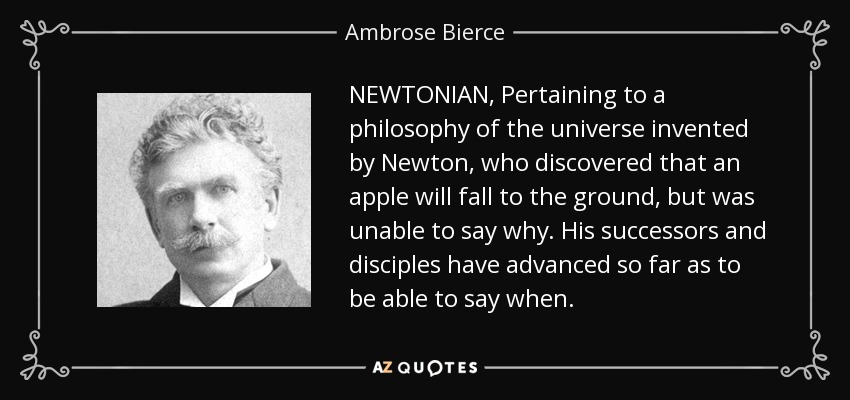
NEWTONIAN, Pertaining to a philosophy of the universe invented by Newton, who discovered that an apple will fall to the ground, but was unable to say why. His successors and disciples have advanced so far as to be able to say when.
Condole - to show that bereavement is a smaller evil than sympathy.
Learning -the kind of ignorance affected by (and affecting) civilized races, as distinguished from ignorance, the sort of learning incurred by savages. See nonsense.
UNITARIAN, n. One who denies the divinity of a Trinitarian.
IMBECILITY, n. A kind of divine inspiration, or sacred fire affecting censorious critics of this dictionary.
ZENITH, n. The point in the heavens directly overhead to a man standing or a growing cabbage. A man in bed or a cabbage in the pot is not considered as having a zenith, though Horizontalists hold that the posture of the body was immaterial.
GNOSTICS, n. A sect of philosophers who tried to engineer a fusion between the early Christians and the Platonists. The former would not go into the caucus and the combination failed, greatly to the chagrin of the fusion managers.
Hurry n: The dispatch of bunglers.
NEPOTISM, n. Appointing your grandmother to office for the good of the party.
GUILLOTINE, n. A machine which makes a Frenchman shrug his shoulders with good reason.
GOOD, adj. Sensible, madam, to the worth of this present writer. Alive, sir, to the advantages of letting him alone.
QUOTIENT, n. A number showing how many times a sum of money belonging to one person is contained in the pocket of another - usually about as many times as it can be got there.
TZETZE (or TSETSE) FLY, n. An African insect ("Glossina morsitans") whose bite is commonly regarded as nature's most efficacious remedy for insomnia, though some patients prefer that of the American novelist ("Mendax interminabilis").
PHYSIOGNOMY, n. The art of determining the character of another by the resemblances and differences between his face and our own, which is the standard of excellence.
Duck-bill, n. Your account at your restaurant during the canvas-back season.
PLEONASM, n. An army of words escorting a corporal of thought.
OBSOLETE, adj. No longer used by the timid. Said chiefly of words. A word which some lexicographer has marked obsolete is ever thereafter an object of dread and loathing to the fool writer . . .
IGNORAMUS, n. A person unacquainted with certain kinds of knowledge familiar to yourself, and having certain other kinds that you know nothing about.
CONSOLATION, n. The knowledge that a better man is more unfortunate than yourself.
PHRENOLOGY, n. The science of picking the pocket through the scalp. It consists in locating and exploiting the organ that one is a dupe with.
ORTHOGRAPHY, n. The science of spelling by the eye instead of the ear.
FORCE, n. "Force is but might," the teacher said p/ "That definition's just."/ The boy said naught but throught instead,/ Remembering his pounded head:/ "Force is not might but must!"
DECALOGUE, n. A series of commandments, ten in number - just enough to permit an intelligent selection for observance, but not enough to embarrass the choice.
POETRY, n. A form of expression peculiar to the Land beyond the Magazines.
WEATHER, n. The climate of an hour. A permanent topic of conversation among persons whom it does not interest, but who have inherited the tendency to chatter about it from naked arboreal ancestors whom it keenly concerned. The setting up of official weather bureaus and their maintenance in mendacity prove that even governments are accessible to suasion by the rude forefathers of the jungle.
Follow AzQuotes on Facebook, Twitter and Google+. Every day we present the best quotes! Improve yourself, find your inspiration, share with friends
or simply: