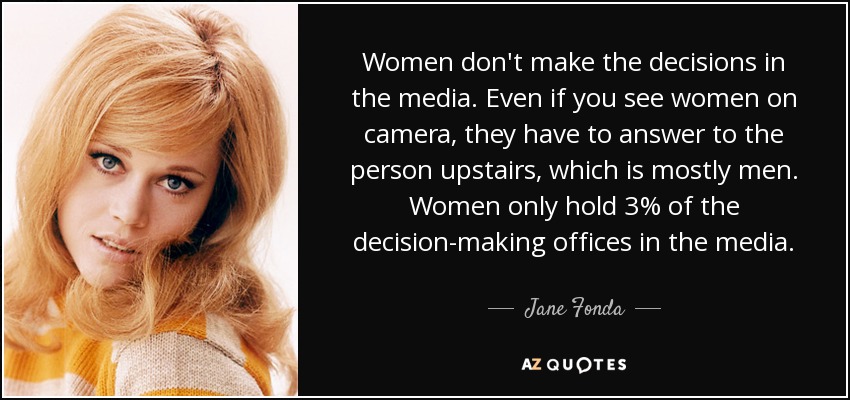
Women don't make the decisions in the media. Even if you see women on camera, they have to answer to the person upstairs, which is mostly men. Women only hold 3% of the decision-making offices in the media.
With the RED, I didn't have this impression at all. I felt that it was as heavy as a film camera. Having this great crew, with the DP and his assistants, I found it making as much of an impression as a very big film camera. I didn't relate to it as much. I remember avoiding it during the shooting rather than paying attention to it.
It seemed to work on camera. And there's very few films - because you make a lot of films and you meet people and you work very intensely and intimately and then you're gone - but there's a few where you actually make friends, and this [The Fall] was one.
The camera guys can't mess up. God bless them, they hardly ever do. But they literally don't know what's going to happen next. None of us do. And it all has to come together and be funny.
I believe that the camera has aided animal welfare by giving a platform and a vision [for bringing] awareness to the most important animal-welfare issues worldwide.
[Brad Furman] wants to try stuff, he's willing to try stuff. And he wants electricity on the camera. And that's what I want, I want electricity whenever I'm performing.
It's a product of being an actor, you know? A lot of your work doesn't end up on camera and some of the best things aren't always in the final product. But yeah, a lot of my stuff got cut and it was painful, but I know it was for the better of the movie.
I would never invite cameras into my life again.
I'm always going to hear people make that connection and I've just accepted it. It's alright. I'm just happy that I get to do my own thing now. I learned a lot from the show [the Voice] as far as being in the TV world and being in front of the camera, which is really great because I'm not as nervous in front of the camera as I was before.
When you disclose something really personal in hopes that the person will then disclose something personal, too? It's all there on camera, your techniques that everyone can see through.
When someone shuts down on you... There were a couple of times of somebody that was just unpleasant, and you can't get them to loosen up. It's this horrible spiral when it's on camera, because you're trying to get them to like you, to trust you, to give you decent answers.
I was trained in the theater, so I really learned a lot about how to work with the camera, just technically speaking, it's been an amazing learning curve.
Sometimes when these kinds of things happen, it can seem a little bit too much to bear. But what I want the people of Louisiana know is that you're not alone on this. Even after the TV cameras leave, the whole country is going to continue to support you and help you until we get folks back in their homes and lives are rebuilt.
Cameras intrigued me.
There was a camera club at Columbia, where I was taking a painting course. And when I went down, somebody showed me how to use the stuff. That's all. I haven't done anything else since then, It was as simple as that. I fell into the business.
Well, in terms of what a camera does. Again, you go back to that original idea that what you photograph is responsible for how it [the photograph] looks. And it's not plastic, in a way. The problem is unique in photographic terms.
The camera's dumb, it don't [sic] care who's pushing the button. It doesn't know.
The terrain of the face is the most dynamic thing you can point the camera at, to me. I love production design and bells and whistles and all of that. I love a technograin as much as the next gal, but a great actor's face? What else should we be looking at?
Actually, acting in bumper cars is terrible, because the really only way to film it and get a close up is to literally mount the camera - this heavy thing on the car and it's just the worst because you can't act at all with a thing on the car.
To all the secret writers, late-night painters, would-be singers, lapsed and scared artists of every stripe, dig out your paintbrush, or your flute, or your dancing shoes. Pull out your camera or your computer or your pottery wheel. Today, tonight, after the kids are in bed or when your homework is done, or instead of one more video game or magazine, create something, anything. Pick up a needle and thread, and stitch together something particular and honest and beautiful, because we need it. I need it. Thank you, and keep going.
There are days when everyone in the world looks like a Diane Arbus to me. She's a genius but her work is completely different to mine. But on those days I don't use my camera.
There are ways of angling the camera. I don't just use a tripod. The only time I did that was in '88 when I first came out of detox, I spent every day doing self-portraits to fit back into my own skin. I didn't know what the world looked like - what I looked like - so in order to fit back into myself, I took self-portraits everyday to give myself courage and to fit the pieces back together. I used a tripod then.
I've been around Hollywood and filmmaking long enough to know that it's a tricky dangerous business when you go on camera, you got to watch yourself.
I am very suspicious of cameras and dramatic interpretations and the whole Hollywood myth-making process. I don't trust it. I've seen it affect people in bad ways.
I have some sort of performing gene that's just there and I cannot explain it but I want to connect with people through a camera or on a stage. I just can do it. I just have an intuitive sense of it. So I love doing that, I love going into that trance.
Follow AzQuotes on Facebook, Twitter and Google+. Every day we present the best quotes! Improve yourself, find your inspiration, share with friends
or simply: