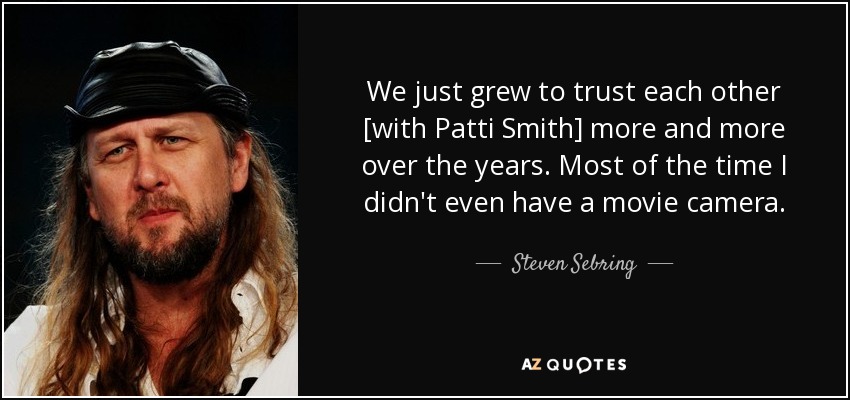
We just grew to trust each other [with Patti Smith] more and more over the years. Most of the time I didn't even have a movie camera.
Sometimes my fashion pictures can look a little bit like documentary style pictures. So having a camera in my hand was normal.
I am going to get officers training to deescalate situations, ban racial profiling, and make body cameras available.
We gave each other a hug, [Richard Pryor] said how much he admired me, I said how much I admired him, and we started working the next morning, and we hit it off really well, and he taught me how to improvise on camera.
I had improvised a lot in classes and at the Actors Studio, but I never did it in front of the camera.
Buddy Hackett [was] talking - this is Hackett, not me - about the Virgin Mary, a limerick sort of thing, and all these children and families ... the look of absolute horror. He's going on and on and on, and finally he stops. It's just total horror, and the camera's still rolling. You can hear it, sort of a grinding noise. And the director says, "Anything else, Bud?"
When I was on set I tried not to bug Steven Soderbergh too much. "Why did you put the camera there?" But he was very open to my questions and definitely being on his set was really thrilling because he's such a master.
'How the West was Won' was very hard, because it was a three cameras technique, meaning three cameras wide. Therefore I wasn't speaking to my fellow performer, I was speaking to a camera, or a line next to the camera. It was difficult to do, because its not real acting. I had to pretend that I was 'seeing' Agnes Moorhead or Jimmy Stewart or Carroll Baker. I wasn't, I was acting to a drawn line. It took me personally two years to make the film, because my character starts at age 16 and I end up being 92 years old in the film. By the end of that production, I was ready for a long nap.
To make things just that much more interesting, the changes can't be captured on camera, so anyone who doesn't see them firsthand thinks it's all some mass hallucination.
It's very easy with the camera to show the positive side of something.
If I was at the Comedy Cellar at midnight you yelled at the back of the room. But you, for television, play it to the camera because yes you're communicating to the people at home using the studio audience that's right in front of you as a guide for that.
The film [ Wyatt Earp and the Holy Grail] was shot on a KODAK Zi8 camera as well as on multiple camera phones. It was processed using the effects of FINAL CUT X and then edited in FINAL CUT 7.
The camera is really the play-by-play person.
I built my own studio. I don't have the professional language to describe it because I'm not a videographer - but I'm a technician. So I get the camera, I get all the things that translate the camera to the computer, I set up a live session, I do the security on it, I set up a background so I can key it out, like newscasters do, and replace it with whatever I want - and I can be anywhere I need to be.
In the age of the camera phone it's a bit weird when you're sitting having dinner in a restaurant and people think they're being very subtle taking a photo while in fact they're being very obvious. When you're in a middle of a mouthful with friends or family and people come up asking for a photograph, that's when you want to say, 'Actually, I'm going to say no; I'd like to finish my meal. This is my time.'
The more we can put the camera in a better place, the more we can take the audience on a more extreme journey with that character.
We did some camera tests blacking it out, we made a prosthetic with a gap in it, but that made me look like a donkey, so I vetoed that right away. And then I just finally called my dentist and said, 'You know, I've had this implant for 20 years. What's it involve in taking it out?' And he said, 'It's actually not that big a deal. We can do that.' So we took it out and I was toothless for three months, for the run of the movie [ The Hangover] .I take my job very seriously.
I actually have come to believe that if people were more connected to their fellow human beings, if we all felt more centred and fulfilled in our lives, maybe we would be pointing our cameras at a lot less social ills.
The modern artist is living in a mechanical age and we have a mechanical means of representing objects in nature such as the camera and photograph. The modern artist, it seems to me, is working and expressing an inner world - in other words - expressing the energy, the motion, and other inner forces.
Kids want to be professional footballers and I think they need to know what it takes to get there - you know, the dedication. People see footballers playing on a Saturday afternoon in front of the TV cameras, but from a Monday to Friday people don't really see what goes on.
I grew up in music theater playing to the audience - singing and dancing and showing off. That's really my background. But the camera's different. I think I'm more at home on stage.
Everybody now has a camera, whether it is a professional instrument or just part of a phone. Landscape photography is a pastime enjoyed by more and more. Getting it right is not an issue. It is difficult to make a mistake with the sophisticated technology we now have. Making a personal and creative image is a far greater challenge.
If I had to give advice to other photographers, I would first suggest quickly getting over the camera equipment questions. In my humble opinion, the make and format of a camera is ultimately low on the priority scale when it comes to making pictures.
I'm an actor that loves to eat on camera. I love it. Something about the act of eating means that you actually can't act as much. You have to be involved in the very real task of trying to ingest sustenance without choking and dying. Something about that process takes the heat off trying to act and often feels more natural.
What I wasn't used to was being in front of the camera.
Follow AzQuotes on Facebook, Twitter and Google+. Every day we present the best quotes! Improve yourself, find your inspiration, share with friends
or simply: