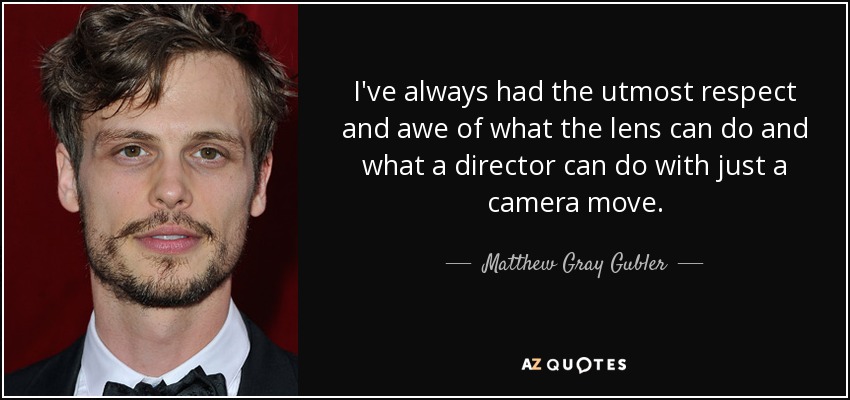
I've always had the utmost respect and awe of what the lens can do and what a director can do with just a camera move.
Silence Of The Lambs is a fantastic film. It's a horror film, and it's an incredibly well-told film that is about point of view in such a unique way. The way that film is shot, the way the eyelines are so close, if not directly into camera, betrays an intimacy with the characters and the audience.
I've been working in Hollywood for a long time now in many different aspects in front of the camera, behind the camera, and I've worked with top executives, presidents of networks. I've worked all around. I see energy and what's around these studios and a lot of these offices. You don't get the high positions in these companies if you don't take advantage of other people in some way. I've seen that around. I've seen that around the studios, whether it's producers or whoever. Egos are there. Greed.
The way I generally work is that I do try to leave as many decisions as I possibly can to the day of, because it feels like that's where you're most in tune to what's going on. I sort of feel like my job is to be a conduit to opportunities, to maximize the creativity of the day itself - because that's when the cameras are running. That's the important thing to me.
Usually people in the acting business end up both in front of and behind the camera. Working for so long in the business, I know how it works. It's not too much of a challenge; the challenge is making it all come together, being in charge of a huge team of people that you trust.
I think you can say a lot with the movement of your camera but you can also say a lot by keeping it still.
The desire to express in an art form and to compose a tableau and vignette whether it's humorous, burlesque, or poetic comes simply from a desire to compose an image for cinema. It is not my fault that when I go to Ramallah there is a checkpoint and therefore it enters my film. Tell me a way to avoid that politicized image. The fact is that the police are everywhere, the army everywhere and occupation is total. Whether it's a love story or a thriller, you place the camera and these realities will cross the frame.
To be honest, everyone thinks that a digital camera is more reliable and every single time I work on any movie, it's just as many problems, the memory card doesn't work or blah blah blah, it overheats; it's the same volume as another camera. I think people are bit taken in by it.
When you're directing you're kind of interested in the movie and the story and the characters. I just sort of prefer the really tough fighting and some of the other street fighting type moves. You know, where it's not just show. It's not dressing it up for the cameras too much. It's pretty down and dirty, the way it should be. That's something I like to do. I do that.
I think if you don't stop an actor every two minutes, changing the position of the camera and the lighting, there is going to be a flow of energy.
Citizen journalism is rapidly emerging as an invaluable part of delivering the news. With the expansion of the Web and the ever-decreasing size and cost of camera phones and video cameras, the ability to commit acts of journalism is spreading to everyone.
When I make a documentary I shoot very little but I hang around with my camera for a long time. I look at the people for a long time through the loop and then when I see something interested then I shoot. I think that I have become very sensitive to these things.
This is going to sound crazy, especially in America where there is a total inflation of the word "love," but in a sense you have to love the people in front of the camera. There has to be trust between the one who is behind the camera and the people on the other side, so that they can relax. They have to feel they are safe, and that way they don't have to pretend just because they are scared.
It has a lot to do with just sort of trust in the relationship that builds between the filmmaker and the subject. There are some people who will never be relaxed in front of a camera, and in some ways that's my failing as a filmmaker to not put them at ease. It's also a function of time, and if you have that type of time.
In media terms, the camera always lies, providing an edited version of reality.
I first discovered YouTube while browsing the web, and then I found people just talking into their cameras. I never even knew it was a thing you could do. William Sledd was my first YouTube obsession. He was so unapologetically himself, and just had fun talking to his audience about things that interested him. I thought - if he could do it, why couldn't I?
I just happened to have my camera and be photographing my friends. It was totally innocent; there was no purpose to the photographs. There was a purity to them that wasn't planned; it was realism. Over the years, the work has changed for me. I know that I have wanted to repeat myself, but I can't. I've been lost a lot of times, but then I'd just get an idea and photograph it. Once I'd started, I'd know exactly what would go down and how it would end. So I just quit doing it, because it loses all interest for me when you know what's going to happen.
When the camera starts to roll, there is something of death about it.
I take his hand, holding on tightly, preparing for the cameras, and dreading the moment when I will finally have to let go.
Whatever she saw beyond the camera lens, beyond the photographer, beyond anything in the known world probably - wasn't fit to be seen.
I don’t keep a travel diary. I did keep a travel diary once and it was a big mistake. All I remember of that trip is what I bothered to write down. Everything else slipped away, as though my mind felt jilted by my reliance on pen and paper. For exactly the same reason I don’t travel with a camera. My holiday becomes the snapshots and anything I forget to record is lost.
He wants as many victors as possible for the cameras to follow in the Capitol. Thinks it makes for better television." "Are you and Beetee going?" I ask. "As many young and attractive victors as possible," Haymitch corrects himself. "So, no. We'll be here.
One time a guy handed me a picture. He said, 'Here's a picture of me when I was younger.' Every picture is of you when you were younger. 'Here's a picture of me when I'm older.' 'You son of bit, how'd you pull that off Let me see that camera. What's it look like'
I don't want to disrespect hip-hop by being something I'm not. I'm Pooch Hall. My strength is in front the camera and holding dialogue.
At least when you're acting you can be someone. In front of the camera you have to be yourself. And who am I?
Follow AzQuotes on Facebook, Twitter and Google+. Every day we present the best quotes! Improve yourself, find your inspiration, share with friends
or simply: