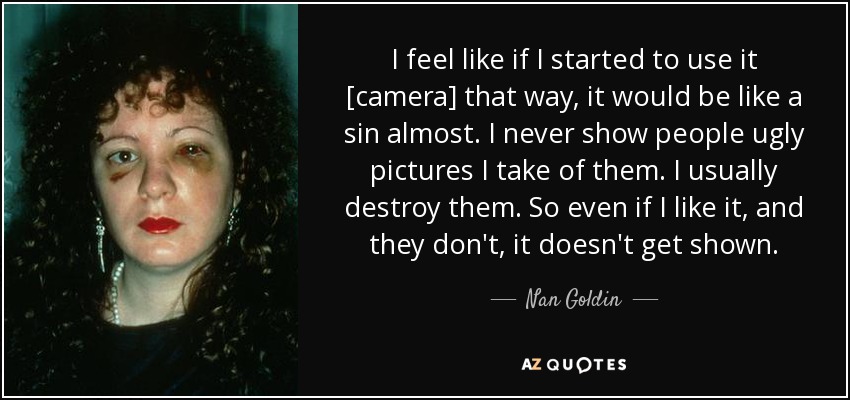
I feel like if I started to use it [camera] that way, it would be like a sin almost. I never show people ugly pictures I take of them. I usually destroy them. So even if I like it, and they don't, it doesn't get shown.
I know what it means to sit in that chair for four or five hours. For me, it's actually thrilling because I get to know something that I'm not used to. The others do that every working day. It's a real commitment, not only in terms of acting in front of a camera, but just in order to get there.
I choose to work behind the camera. And I kind of want to make the work and then run away. The presentation of myself really feels complicated for me.
You're talking about a whole camera crew and being mic'd up professionally everyday and just having another group of people following you around. It's a little different than having friends pick up a camera and follow you around.
Initially, it connected with me when I was a kid, seeing a lot of movies while growing up in Los Angeles. And Sam's [Fuller] pictures are an expression of such a distinct voice that he was one of those filmmakers who made me aware that there was, in fact, a real presence behind the camera that was telling the story, as opposed to actors just presenting it.
Once the cameras rolling or the audience is in the seats, I'm on. I can't help it. I go into a trance.
I have some sort of performing gene that's just there and I cannot explain it but I want to connect with people through a camera or on a stage. I just can do it. I just have an intuitive sense of it. So I love doing that, I love going into that trance.
I'm the front man, I'm the man on camera, but there's a whole team beyond me.
Fashion was very important to me because I could practice my acting skills, I could practice working with the camera, I could work with amazing photographers. It just gave me a different field of work.
I'm a tough girl, I know what my job entails - it entails a lot more than standing in front of the camera. So I get it. I won't deny the physicality of it is exhausting, and sometimes my body just can't keep up. But it is ultimately about mind over matter.
I invented a camera that has an exposure time of one hundred years and the camera works in the simplest possible terms, because anything more complicated is more likely to break down in one way or another. It's a pinhole camera that lets in very low light and instead of exposing film, which is going to spoil within a matter of days or weeks, I'm using ordinary black paper.
I had to learn how to modulate my performances and interpretations of these roles in auditions for the camera.
I want to rob a bank so much - and I'm from the Midwest, so we have like one bank, no security cameras, and so I designed this thing.
For example, in my dorm, at the University of Kentucky, I had the only camera. I don't think anyone came to college with a camera, other than me.
I'm doing an over-the-shoulder shot on a dog. I'm putting the camera behind the dog's shoulder. This is craziness. You just accept it in the movie [Valley of Violence], but when you make the movie, it's the weirdest thing. There's dog coverage, like it's a person.
When I moved to London, you could park your motorcycle in the pavement, on the sidewalk. We would stay here and just leave it and go about your business. But now something was sort of encroaching in London. There's cameras everywhere. You can't do anything. You're not allowed to be in a group.
I use the camera as a dumb copying device that only serves to document whatever phenomenon appears before it through the conditions set by a system. No esthetic choices are possible. Other people often make the photographs. It makes no difference.
I can't tell if the world is worse now or if we just have more cameras. There are cameras everywhere, so now the world knows how bad the world is.
By the time I got to the league I knew the cameras were going to be there and to turn it on.
I am very proud of my husband, both behind the camera and in front of the camera.
When Javy Baez goes out there, man, you saw him before the game sitting on the bench, saw him waving into the camera, he's just being himself. I love that.
I don't like horror, which is ridiculous because I've been in three horror movies, but when I see those things, I see camera tricks and fake blood and actors screaming and I don't know understand why other actors don't see that.
You just have to learn certain technical things, like where the camera is, not to block people's light in your own, to hit your marks, and that you do it kind of piecemeal.
Kathie Lee [Gifford] invited me to come to New York for lunch with her - and surprised with an unexpected shout out again for One Thousand Gifts on the show and graciously asked a few questions on camera. Indebted to her and the people who read and looked for Jesus in the pages and shared the hope and joy of Him - right where they are.
I run my own film school, the Rogue Film School, and I do it over three and a half days, eight hours non-stop everyday; alone, single-handedly. But the difference is in the Rogue Film School I do have real human beings in front of me from all over the world, and of course there's this course as well, they can ask, talk about their problems and obstacles, finances, anything, you just name it. Whereas in the Masterclass, you are speaking to cameras.
Follow AzQuotes on Facebook, Twitter and Google+. Every day we present the best quotes! Improve yourself, find your inspiration, share with friends
or simply: