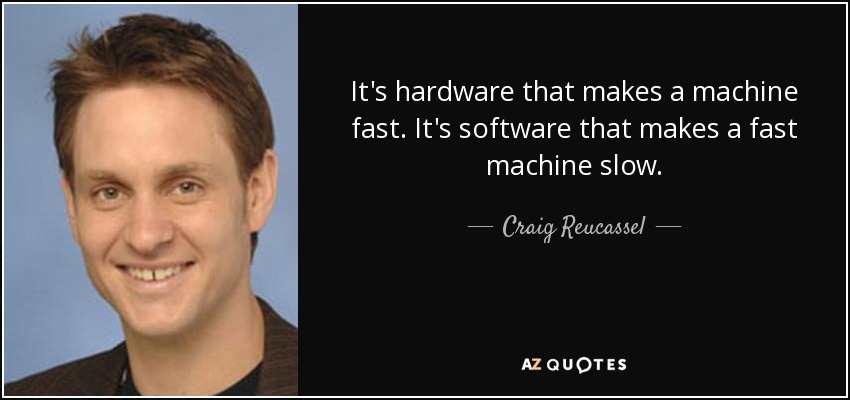
It's hardware that makes a machine fast. It's software that makes a fast machine slow.
As a rule, software systems do not work well until they have been used, and have failed repeatedly, in real applications.
When I write software, I know that it will fail, either due to my own mistake, or due to some other cause.
Software comes from heaven when you have good hardware.
It's hard to read through a book on the principles of magic without glancing at the cover periodically to make sure it isn't a book on software design.
Wit and puns aren't just décor in the mind; they're essential signs that the mind knows it's on, recognizes its own software, can spot the bugs in its own program.
One of the great skills in using any language is knowing what not to use, what not to say. There's that simplicity thing again.
Originally, I wanted a machine that would cost $100. My idea was to spend nothing on the console technology so all the money could be spent on improving the interface and software. If we hadn't used NAND flash memory and other pricey parts, we might have succeeded.
A little retrospection shows that although many fine, useful software systems have been designed by committees and built as part of multipart projects, those software systems that have excited passionate fans are those that are the products of one or a few designing minds, great designers.
Tip: Take the stodgiest, oldest, slowest moving industry you can find. And build amazing software for it.
Here's the problem right now; the person who is savvy enough to want to have a good PC to upgrade their video card, is a person who is savvy enough to know bit torrent to know all the elements so they can pirate software. Therefore, high-end videogames are suffering very much on the PC.
Companies in every industry need to assume that a software revolution is coming.
Over the next 10 years, I expect many more industries to be disrupted by software, with new world-beating Silicon Valley companies doing the disruption in more cases than not.
It is food - we now know that food is information, not just calories, and that it can upgrade your biologic software. The majority of chronic disease is primarily a food borne illness. We ate ourselves into this problem and we have to eat ourselves out of it.
No one should expect building a new high-growth, software-powered company in an established industry to be easy. It's brutally difficult.
In short, software is eating the world
More and more major industries are being run on software and delivered as online services—from movies to agriculture to national defense. Many of the winners are Silicon Valley-style entrepreneurial technology companies that are invading and overturning established industry structures. Over the next 10 years, I expect many more industries to be disrupted by software, with new world-beating Silicon Valley companies doing the disruption in more cases than not.
I regularly read Internet user groups filled with messages from people trying to solve software incompatibility problems that, in terms of complexity, make the U.S. Tax Code look like Dr. Seuss.
Digital art software has empowered both the painterly side of photographers, and the photographer side of painters.
This is what our customers are asking for to take them to the next level and free them from the bondage of mainframe and client-server software.
Crappy old OSes have value in the basically negative sense that changing to new ones makes us wish we'd never been born.
I love software, because if you can imagine something, you can build it.
If you love a medium made of software, there's a danger that you will become entrapped in someone else's recent careless thoughts. Struggle against that.
It's called 'reading'. It's how people install new software into their brains.
Any editing, software work, and mail is done in this exported Plan 9
Follow AzQuotes on Facebook, Twitter and Google+. Every day we present the best quotes! Improve yourself, find your inspiration, share with friends
or simply: