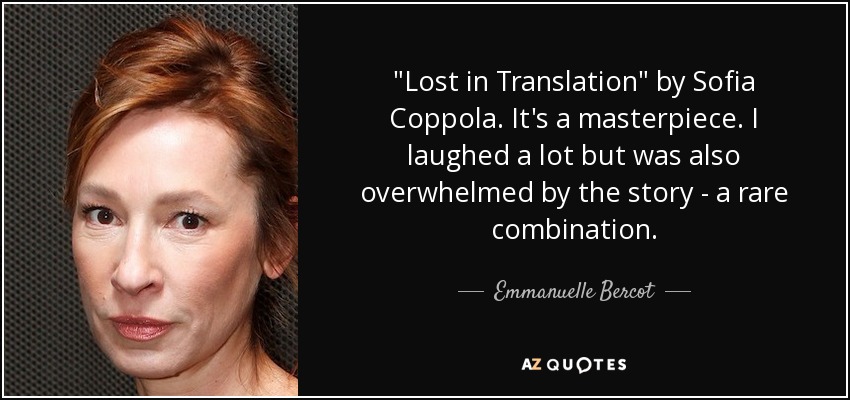
"Lost in Translation" by Sofia Coppola. It's a masterpiece. I laughed a lot but was also overwhelmed by the story - a rare combination.
I've translated a lot of American literature into Japanese, and I think that what makes a good translator is, above all, a feel for language and also a great affection for the work you're translating. If one of those elements is missing the translation won't be worth much.
I find Japanese books quite baffling when I read them in translation. It's only with Haruki Murakami that I find Japanse fiction that I can understand and relate to. He's a very international writer.
I do believe that one's writing life needs to be kept separate from Po-Biz. Personally, I deal with this by not attending too many poetry readings, primarily reading dead poets or poems in translation, reading Poets & Writers only once for grant/contest information before I quickly dispose of it, and not reading Poetry Daily. Ever.
There's a Cuban saying: Bicho malo nunca muere. Loose translation: The good die young but the wicked live forever. It seems to apply to Fidel. I hope it applies to me.
I tend to be kind of literal about translation. I think it's important to present the writer as closely as possible.
We find our voice, we lose our voice, we retrieve it, honor it, and hopefully, learn how to share it with others and stand in the center of our power. Translation is a theme. Fear and courage are a theme.
If you are forced to describe things for someone else, it sharpens your senses. And also your sense of how hard it is to make the translation from the vibrant, multi-faceted world to a sentence that distils it.
There is an old Italian proverb about the nature of translation: "Traddutore, traditore!" This means simply, "Translators-traitors!" Of course, as you can see, something is lost in the translation of this pithy expression: there is great similarity in both the spelling and the pronunciation of the original saying, but these get diluted once they are put in English dress. Even the translation of this proverb illustrates its truth!
The problem of translation is to retreat to a simpler tenor of one's own style and creatively adjust this to one's author.
Whatever you do, trample down abuses, and love those who love you. Different translation: Whatever you do, crush the infamous thing superstition, and love those who love you.
Any adaptation is a translation, and there is such a thing as an unreadably faithful translation; and I believe a degree of reinterpretatio n for the new language may be not only inevitable but desirable.
To translate, one must have a style of his own, for the translation will have no rhythm or nuance, which come from the process of artistically thinking through and molding the sentences; they cannot be reconstituted by piecemeal imitation. The problem of translation is to retreat to a simpler tenor of one’s own style and creatively adjust this to one’s author.
Pound's translation of Chinese poetry was maybe the most important thing I read. Eliot a little bit later.
Not to admire, is all the art I know To make men happy, or to keep them so. Thus Horace wrote we all know long ago; And thus Pope quotes the precept to re-teach From his translation; but had none admired, Would Pope have sung, or Horace been inspired?
We can write the new chapters in a visual language whose prose and poetry will need no translation.
The joy of painting lies precisely in the challenge of memory and the challenge of translation from the lived experience to the two-dimensional or three-dimensional symbol.
As strange as this may sound, I very seldom read fiction. Because my novels require so much research, almost everything I read is non - fiction - histories, biographies, translations of ancient texts.
I'm told that a couple of my Russian translations are just plain terrible, though, and there may be others.
There's something, I think, that gets lost when we write something - something gets lost in the translation. So I speak everything out, and it's more important how it sounds. And applying that to more formal aspects of writing.
Nor ought a genius less than his that writ attempt translation.
I'd done a drawing of the model using only peripheral vision, looking at a spot on the wall to the right of where she sat. It wasn't really a drawing of her I produced; it was a drawing of the cloud of lights and darks she dissolved into when I focused on the spot. You could look at my drawing of this cloud and read it as a nude female figure, though a little translation was required.
Readable, faithful, accurate-what more could you ask for in a modern translation of the Bible? GOD'S WORD Translation is a great version for enhancing your love for God's Word. I recommend it.
Better known as the Secret of the Golden Flower, this is a famous neidan text that the Western world came to know through Richard Wilhelm's 1929 translation. The Chinese text used by Wilhelm was edited by Zhanran Huizhen zi in 1921. Besides this, at least five more versions are available, all of which date to the late Qing dynasty (1644-1911) and are ascribed to Lu Dongbin, who revealed them through spirit writing.
So much gets lost in the translation. Even if you sat there listening to it with a microscope, there's no way you're gonna find out what it means.
Follow AzQuotes on Facebook, Twitter and Google+. Every day we present the best quotes! Improve yourself, find your inspiration, share with friends
or simply: