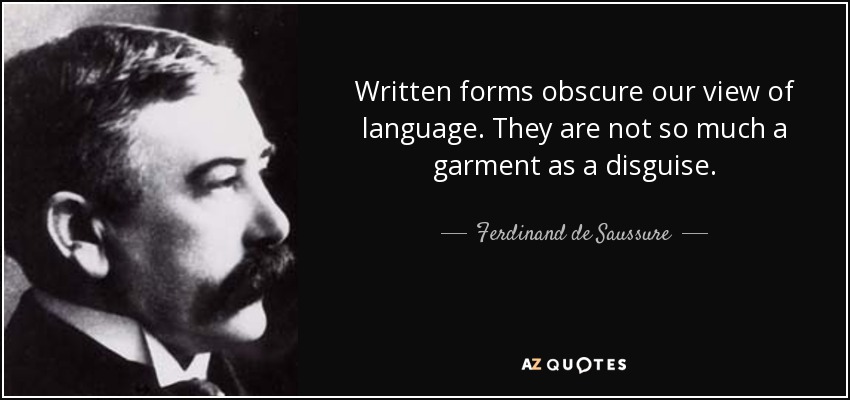
Written forms obscure our view of language. They are not so much a garment as a disguise.
There are few efforts more conducive to humility than that of the translator trying to communicate an incommunicable beauty. Yet, unless we do try, something unique and never surpassed will cease to exist except in the libraries of a few inquisitive book lovers.
The slovenliness of our language makes it easier for us to have foolish thoughts.
I have always maintained that translation is essentially the closest reading one can possibly give a text. The translator cannot ignore "lesser" words, but must consider every jot and tittle.
A national language is a band of national union.
The Haitians, who knew something about suffering and survival, had a beautiful phrase... The Translation is not perfect, but the nut of it was: 'The season of pain is never over until the sky begins to cry.
Christopher Lynch has made the best and the first careful translation of Machiavelli's Art of War. With useful notes, an excellent introduction, an interpretive essay, glossary, and index, it is a treasure for readers of military history and Renaissance thought as well as for lovers of Machiavelli.
Polly Findlay showed real insight and imagination in her production of my translation of Seneca's Thyestes at the Arcola. I enjoyed her use of the space and the detail of her work with the actors, and I'm looking forward to seeing what she does with Light Shining.
In my writing, I strive for a lyrical beauty somewhere between Tolkien at his best and Seamus Heaney's translation of Beowulf.
Translation is that which transforms everything so that nothing changes.
And after I started working for the Bureau, most of my translation duties included translations of documents and investigations that actually started way before 9/11.
Fidelity to meaning alone in translation is a kind of betrayal.
The first rule of translation: make sure you know at least one of the bloody languages!
Every act of communication is an act of translation.
When you begin to read a poem you are entering a foreign country whose laws and language and life are a kind of translation of your own; but to accept it because its stews taste exactly like your old mother's hash, or to reject it because the owl-headed goddess of wisdom in its temple is fatter than the Statue of Liberty, is an equal mark of that want of imagination, that inaccessibility to experience, of which each of us who dies a natural death will die.
No one really knew the sciences except the Lord Robert, Bishop of Lincoln, by reason of his length of life and experience, as well as of his studiousness and zeal. He knew mathematics and perspective, and there was nothing which he was unable to know; and at the same time he was sufficiently acquainted with languages to be able to understand the saints and the philosophers and the wise men of antiquity but his knowledge of languages was not such as to enable him to effect translations until the latter portion of his life.
Above all, the translation of books into digital formats means the destruction of boundaries. Bound, printed texts are discrete objects: immutable, individual, lendable, cut off from the world.
If you just read the book, you're taking in the narrative, you're taking in the characters, you're understanding it in a certain way. If you make a movie it's really an act of translation.
The New York Times is the worst in that hardly anybody can write English over there. Most of it reads like slight translations from the German.
To be frank: the translations that often sound bad in the mouths of the actors, these have often been done by linguists.
The translation process becomes a highly subjective thing - turning reds and blues into black-and-whiteness. It's really bizarre for me.
The labours I devoted between 1888 to 1900 to the critical edition, translation and commentary of Kalhana's Rajatarangini, the only true historical text of Sanskrit literature, afforded me ample opportunities of gaining close contact with Sanskrit savants of Kashmir, the land where traditional learning of Hindu India had flourished in old times greatly and survived until recent years.
Khairani Barokka is a writer, spoken-word poet, visual artist and performer whose work has a strong vein of activism, particularly around disability, but also how this intersects with, for example, issues of gender - she's campaigned for reproductive rights in her native Indonesian, and is currently studying for a PhD in disability and visual cultures at Goldsmiths. She's written a feminist, environmentalist, anti-colonialist narrative poem, with tactile artwork and a Braille translation. How could I not publish that?
Well, the role of our "allies," in my view, is a scandal. 53 other countries cooperated in the kidnapping, "extraordinary rendition," of suspected terrorists to black sites where they were administered enhanced interrogation techniques, which by the way is a direct, literal translation of "verschärfte Vernehmung" right out of the Gestapo manual.
Some of my colleagues are surprised by how little personal interaction I've had with "my" authors, but I don't translate to go fishing for friends. Part of me suspects that they wouldn't like me, or that I wouldn't like them, which would inevitably get in the way of the mission. None of the theory built around translation matters to me anyway: much of the process, I find, is intuitive.
Follow AzQuotes on Facebook, Twitter and Google+. Every day we present the best quotes! Improve yourself, find your inspiration, share with friends
or simply: