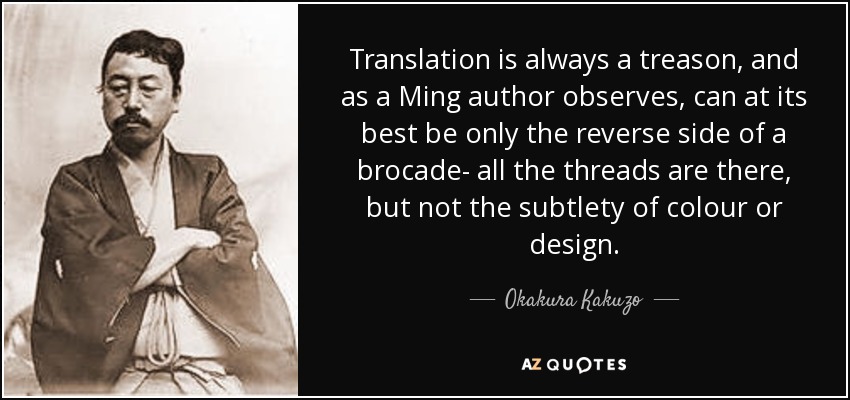
Translation is always a treason, and as a Ming author observes, can at its best be only the reverse side of a brocade- all the threads are there, but not the subtlety of colour or design.
Music is the voice of all sorrow, all joy. It needs no translation.
A massive and brilliant accomplishment--the first English translation of the original Grimm brothers' fairy tales. The plain telling is that much more forceful for its simplicity and directness, particularly in scenes of naked self-concern and brutality. Hate, spite, love, magic, all self-evident, heartbreaking, delightful. I will return to this book over and over, no doubt about it.
I think if I'd gone to an MFA program and learned that, it would have been money well spent. But translation has been that for me.
The goal of Bible translation is: be transparent to the original text - to see as clearly as possible what the biblical authors actually wrote.
Without translation, I would be limited to the borders of my own country. The translator is my most important ally. He introduces me to the world.
The director works as an interpretive artist, but he's still an artist, so you also have to give him room to create and to put his vision of the play or his translation or interpretation of the material on the stage.
There is an inimitable grace in Virgil's words, and in them principally consists that beauty which gives so inexpressible a pleasure to him who best understands their force. This diction of his, I must once again say, is never to be copied; and since it cannot, he will appear but lame in the best translation.
If men were able to be convinced that art is a precise advance knowledge of how to cope with the psychic and social consequences of the next technology, would they all become artist? Or would they begin a careful translation of new art forms into social navigation charts? I am curious to know what would happem if art were suddenly seen for what it is, namely, exact information of how to rearrange one's psyche in order to anticipate the next blow from our own extended faculties.
On quantum theory I use up more brain grease (rough translation of German idiom) than on relativity.
Total experiences, of which there are many kinds, tend again and again to be apprehended only as revivals or translations of the religious imagination. To try to make a fresh way of talking at the most serious, ardent, and enthusiastic level, heading off the religious encapsulation, is one of the primary intellectual tasks of future thought.
How does newness come into the world? How is it born? Of what fusions, translations, conjoinings is it made? How does it survive, extreme and dangerous as it is? What compromises, what deals, what betrayals of its secret nature must it make to stave off the wrecking crew, the exterminating angel, the guillotine? Is birth always a fall? Do angels have wings? Can men fly?
In art as in life, some things need no translation.
Mathematics to me is like a language I don’t speak though I admire its literature in translation.
A forward critic often dupes us With sham quotations peri hupsos, And if we have not read Longinus, Will magisterially outshine us. Then, lest with Greek he over-run ye, Procure the book for love or money, Translated from Boileau's translation, And quote quotation on quotation.
I will venture to assert, that a just translation of any ancient poet in rhyme is impossible. No human ingenuity can be equal to the task of closing every couplet with sounds homotonous, expressing at the same time the full sense, and only the full sense of his original.
I would feel pretty embarrassed if I was doing what I do and I wasn't at least attempting the eloquent translation of the human experience in some way.
Generally risk-averse, specialist translation imprints have also hollowed out a fairly comfortable niche for themselves: they get ninety percent of the profits for ten percent of the work, often largely funding their operations - and their salaries - through grants that they don't even apply for. If it wasn't for publicly-funded arts bodies and organizations such as PEN, I wouldn't have been able to work on either [Abdellatif] Laâbi or [ Rashid ] Boudjedra.
The translation of the Veda will hereafter tell to a great extent on the fate of India and on the growth of millions of souls in that country. It is the root of their religion, and to show them what the root is, I feel sure, is the only way of uprooting all that has sprung from it during the last 3000 years.
Pour e crire ce livre essentiel, le seul livre vrai, un grand e crivain n'a pas, dans le sens courant, a' l'inventer puisqu'il existe de j a' en chacun de nous, mais a' le traduire. To write the essential book, the only true book, a great writerdoesnot needto invent becausethebook already exists inside each one of us and merely needs translation.
You've often heard me say - perhaps too often - that poetry is what is lost in translation. It is also what is lost in interpretation. That little poem means just what it says and it says what it means, nothing less but nothing more.
How truly language must be regarded as a hindrance to thought, though the necessary instrument of it, we shall clearly perceive on remembering the comparative force with which simple ideas are communicated by signs. To say, "Leave the room," is less expressive than to point to the door. Place a finger on the lips is more forcible than whispering, "Do not speak." A beck of the hand is better than, "Come here." No phrase can convey the idea of surprise so vividly as opening the eyes and raising the eyebrows. A shrug of the shoulders would lose much by translation into words.
There is no muse of philosophy, nor is there one of translation.
In every art we are always obliged to return to the accepted means of expression, the conventional language of the art. What is a black-and-white drawing but a convention to which the beholder has become so accustomed that with his mind's eye he sees a complete equivalent in the translation from nature?
Prophecy is rash, but it may be that the publication of D.T. Suzuki's first Essays in Zen Buddhism in 1927 will seem to future generations as great an intellectual event as William of Moerbeke's Latin translations of Aristotle in the thirteenth century or Marsiglio Ficino's of Plato in the fifteenth.
Follow AzQuotes on Facebook, Twitter and Google+. Every day we present the best quotes! Improve yourself, find your inspiration, share with friends
or simply: