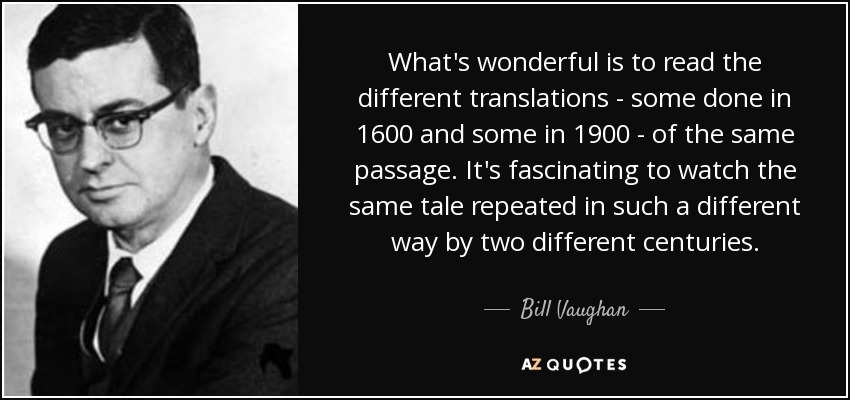
What's wonderful is to read the different translations - some done in 1600 and some in 1900 - of the same passage. It's fascinating to watch the same tale repeated in such a different way by two different centuries.
I'd done a drawing of the model using only peripheral vision, looking at a spot on the wall to the right of where she sat. It wasn't really a drawing of her I produced; it was a drawing of the cloud of lights and darks she dissolved into when I focused on the spot. You could look at my drawing of this cloud and read it as a nude female figure, though a little translation was required.
Readable, faithful, accurate-what more could you ask for in a modern translation of the Bible? GOD'S WORD Translation is a great version for enhancing your love for God's Word. I recommend it.
A screenplay is really an instruction manual, and it can be interpreted in any number of ways. The casting, the choice of location, the costumes and make-up, the actors' reading of a line or emphasis of a word, the choice of lens and the pace of the cutting - these are all part of the translation.
So much gets lost in the translation. Even if you sat there listening to it with a microscope, there's no way you're gonna find out what it means.
I have nothing but wastes and wilds of self-translation before me for many miserable months to come.
Poetry is that which is lost in translation.
I don't know what exactly the translation is but when we do consume something now, something else has to give at some point.
Ko Un is a crucial poet for the twenty-first century, and this is an enormously fresh and vivid translation.
Often touching . . . Monumental Propaganda is a novel that slashes and rips . . . In his translation, Andrew Bromfield deftly shifts his tone and tools as required, remaining true to Voinovich's Vonnegut-like playfulness and appreciation of the absurb.
A play is basically a long, formalistic polemic. You can write it without the poetry, and if you do, you may have a pretty good play. We know this because we see plays in translation. Not many people speak Norwegian or Danish or whatever guys like Ibsen spoke, or Russian - yet we understand Chekhov and the others.
To translate kinesics or paralinguistic messages into words is likely to introduce gross falsification due not merely to the human propensity for trying to falsify statements about "feelings" and relationship and to the distortions which arise whenever the products of one system of coding are dissected onto the premises of another, but especially to the fact that all such translation must give to the more or less unconscious and involuntary message the appearance of conscious intent.
Air power speaks a strategic language so new that translation into the hackneyed idiom of the past is impossible.
Never trust the translation or interpretation of something without first trusting its interpreter.
I've always gone with Kafka's model of establishing the world from the first line, as in Kafka's famous line from Metamorphosis, "Gregor Samsa woke up from uneasy dreams to find himself transformed into a gigantic insect" (or beetle or cockroach, depending on the translation). I have to have that first line before I can go further.
Whatever your Bible translation is, it stands on the shoulders of one man - William Tyndale.
In case any are puzzled by the different translations from which I draw strength and help and delight, it is like this: In studying any object with the microscope we use different lenses and turn the mirror in various ways; each change brings out some new wonder and beauty. So it is for those who are not Greek or Hebrew scholars, and who use the work of scholars to open the meaning of the exhaustible Word-the Bible is richer than any single version can fully show.
When my books were translated, it was always about the characters, because the unique language aspect was lost in translation.
I think if I'd gone to an MFA program and learned that, it would have been money well spent. But translation has been that for me.
I mainly wanted non-english writing poets, because I loved the idea that I was translating translations.
I've translated a lot of American literature into Japanese, and I think that what makes a good translator is, above all, a feel for language and also a great affection for the work you're translating. If one of those elements is missing the translation won't be worth much.
I find Japanese books quite baffling when I read them in translation. It's only with Haruki Murakami that I find Japanse fiction that I can understand and relate to. He's a very international writer.
I do believe that one's writing life needs to be kept separate from Po-Biz. Personally, I deal with this by not attending too many poetry readings, primarily reading dead poets or poems in translation, reading Poets & Writers only once for grant/contest information before I quickly dispose of it, and not reading Poetry Daily. Ever.
There's a Cuban saying: Bicho malo nunca muere. Loose translation: The good die young but the wicked live forever. It seems to apply to Fidel. I hope it applies to me.
I tend to be kind of literal about translation. I think it's important to present the writer as closely as possible.
Follow AzQuotes on Facebook, Twitter and Google+. Every day we present the best quotes! Improve yourself, find your inspiration, share with friends
or simply: