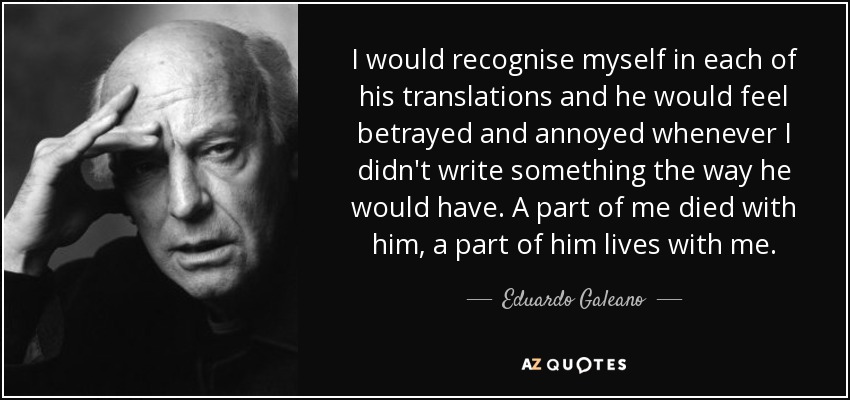
I would recognise myself in each of his translations and he would feel betrayed and annoyed whenever I didn't write something the way he would have. A part of me died with him, a part of him lives with me.
Horace, who had been trying to find out the meaning of Kurokuma for some time now, was pleased to hear the translation. "Black bear," he repeated. "It's undoubtedly because I'm so terrible in battle." "I'd guess so," Will put in. "I've seen you in battle and you're definitely terrible.
I emphasize the distinction between brackets and no brackets because it will affect your reading experience, if you will allow it. Brackets are exciting. Even though you are approaching Sappho in translation, that is no reason you should miss the drama of trying to read a papyrus torn in half or riddled with holes or smaller than a postage stamp--brackets imply a free space of imaginal adventure.
Truth lives in the spaces between words. It defies translation.
Wo die Liebe herrscht, da gibt es keinen machtwillen, und wo die macht den vorrang hat, da fehlt die Liebe. Das eine ist der Schatten des andern. Translation: Where love rules, there is no will to power; and where power predominates, there love is lacking. The one is the shadow of the other.
I could define poetry this way: it is that which is lost out of both prose and verse in translation.
It skims in through the eye, and by means of the utterly delicate retina hurls shadows like insect legs inward for translation. Then an immense space opens up in silence and an endlessly fecund sub-universe the writer descends, and asks the reader to descend after him, not merely to gain instructions but also to experience delight, the delight of mind freed from matter and exultant in the strength it has stolen from matter.
The possibility of interpretation lies in the identity of the observer with the observed. Each material thing has its celestial side; has its translation, through humanity, into the spiritual and necessary sphere, where it plays a part as indestructible as any other.
Fashion anticipates, and elegance is a state of mind ... a mirror of the time in which we live, a translation of the future, and should never be static.
The word mantra comes from two Sanskrit words man, ("to think") and tra ("tool'). So the literal translation is "a tool of thought." And that's how mantras are used in Buddhist and Hindu practices, as tools that clear your mind of distractions. Because when you focus on repeating that mantra over and over again, soon the noise will die down and all you will hear is your inner voice.
If a little less time was devoted to the translation of letters by Julius Caesar describing Britain 2000 years ago and a little more time was spent on teaching children how to describe (in simple modern English) the method whereby ethylene was converted into polythene in 1933 in the ICI laboratories at Northwich, and to discussing the enormous social changes which have resulted from this discovery, then I believe that we should be training future leaders in this country to face the world of tomorrow far more effectively than we are at the present time.
Many pictures turn out to be limp translations of the known world instead of vital objects which create an intrinsic world of their own. There is a vast difference between taking a picture and making a photograph.
Translations are a partial and precious documentation of the changes the text suffers.
Of all social institutions language is least amenable to initiative. It blends with the life of society, and the latter, inert by nature, is a prime conservative force.
Written forms obscure our view of language. They are not so much a garment as a disguise.
There are few efforts more conducive to humility than that of the translator trying to communicate an incommunicable beauty. Yet, unless we do try, something unique and never surpassed will cease to exist except in the libraries of a few inquisitive book lovers.
The slovenliness of our language makes it easier for us to have foolish thoughts.
I have always maintained that translation is essentially the closest reading one can possibly give a text. The translator cannot ignore "lesser" words, but must consider every jot and tittle.
A national language is a band of national union.
The first rule of translation: make sure you know at least one of the bloody languages!
Every act of communication is an act of translation.
When you begin to read a poem you are entering a foreign country whose laws and language and life are a kind of translation of your own; but to accept it because its stews taste exactly like your old mother's hash, or to reject it because the owl-headed goddess of wisdom in its temple is fatter than the Statue of Liberty, is an equal mark of that want of imagination, that inaccessibility to experience, of which each of us who dies a natural death will die.
No one really knew the sciences except the Lord Robert, Bishop of Lincoln, by reason of his length of life and experience, as well as of his studiousness and zeal. He knew mathematics and perspective, and there was nothing which he was unable to know; and at the same time he was sufficiently acquainted with languages to be able to understand the saints and the philosophers and the wise men of antiquity but his knowledge of languages was not such as to enable him to effect translations until the latter portion of his life.
The labours I devoted between 1888 to 1900 to the critical edition, translation and commentary of Kalhana's Rajatarangini, the only true historical text of Sanskrit literature, afforded me ample opportunities of gaining close contact with Sanskrit savants of Kashmir, the land where traditional learning of Hindu India had flourished in old times greatly and survived until recent years.
Khairani Barokka is a writer, spoken-word poet, visual artist and performer whose work has a strong vein of activism, particularly around disability, but also how this intersects with, for example, issues of gender - she's campaigned for reproductive rights in her native Indonesian, and is currently studying for a PhD in disability and visual cultures at Goldsmiths. She's written a feminist, environmentalist, anti-colonialist narrative poem, with tactile artwork and a Braille translation. How could I not publish that?
Follow AzQuotes on Facebook, Twitter and Google+. Every day we present the best quotes! Improve yourself, find your inspiration, share with friends
or simply: