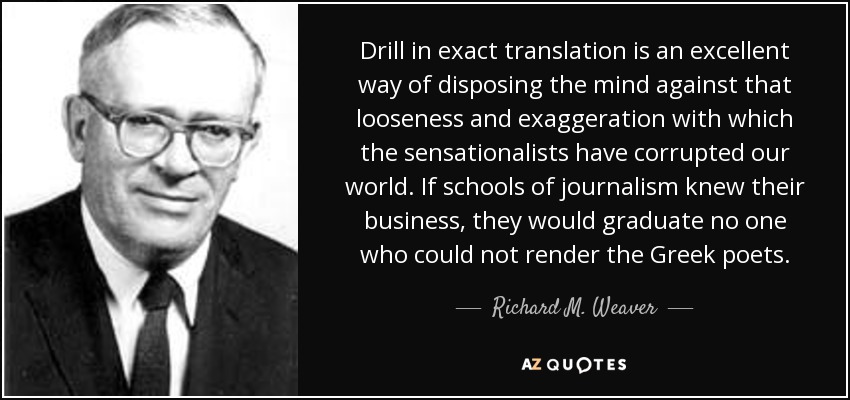
Drill in exact translation is an excellent way of disposing the mind against that looseness and exaggeration with which the sensationalists have corrupted our world. If schools of journalism knew their business, they would graduate no one who could not render the Greek poets.
I have made a very rude translation of the Seven against Thebes, and Pindar too I have looked at, and wish he was better worth translating. I believe even the best things are not equal to their fame. Perhaps it would be better to translate fame itself,--or is not that what the poets themselves do? However, I have not done with Pindar yet.
Faction is the greatest evil and the most common danger. "Faction" is the conventional English translation of the Greek stasis, one of the most remarkable words to be found in any language.
The heroic books, even if printed in the character of our mother tongue, will always be in a language dead to degenerate times; and we must laboriously seek the meaning of each word and line, conjecturing a larger sense than common use permits out of what wisdom and valor and generosity we have. The modern cheap and fertile press, with all its translations, has done little to bring us nearer to the heroic writers of antiquity. They seem as solitary, and the letter in which they are printed as rare and curious, as ever.
I'm interested in the murky areas where there are no clear answers - or sometimes multiple answers. It's here that I try to imagine patterns or codes to make sense of the unknowns that keep us up at night. I'm also interested in the invisible space between people in communication; the space guided by translation and misinterpretation.
Above all, the translation of books into digital formats means the destruction of boundaries. Bound, printed texts are discrete objects: immutable, individual, lendable, cut off from the world.
If you just read the book, you're taking in the narrative, you're taking in the characters, you're understanding it in a certain way. If you make a movie it's really an act of translation.
The New York Times is the worst in that hardly anybody can write English over there. Most of it reads like slight translations from the German.
To be frank: the translations that often sound bad in the mouths of the actors, these have often been done by linguists.
The translation process becomes a highly subjective thing - turning reds and blues into black-and-whiteness. It's really bizarre for me.
The labours I devoted between 1888 to 1900 to the critical edition, translation and commentary of Kalhana's Rajatarangini, the only true historical text of Sanskrit literature, afforded me ample opportunities of gaining close contact with Sanskrit savants of Kashmir, the land where traditional learning of Hindu India had flourished in old times greatly and survived until recent years.
Khairani Barokka is a writer, spoken-word poet, visual artist and performer whose work has a strong vein of activism, particularly around disability, but also how this intersects with, for example, issues of gender - she's campaigned for reproductive rights in her native Indonesian, and is currently studying for a PhD in disability and visual cultures at Goldsmiths. She's written a feminist, environmentalist, anti-colonialist narrative poem, with tactile artwork and a Braille translation. How could I not publish that?
Well, the role of our "allies," in my view, is a scandal. 53 other countries cooperated in the kidnapping, "extraordinary rendition," of suspected terrorists to black sites where they were administered enhanced interrogation techniques, which by the way is a direct, literal translation of "verschärfte Vernehmung" right out of the Gestapo manual.
Some of my colleagues are surprised by how little personal interaction I've had with "my" authors, but I don't translate to go fishing for friends. Part of me suspects that they wouldn't like me, or that I wouldn't like them, which would inevitably get in the way of the mission. None of the theory built around translation matters to me anyway: much of the process, I find, is intuitive.
I would say it was [ifluence] all the Greeks and the Russian classics like [Lev] Tolstoy, [Andrey] Goncharov,[Fedor] Dostoyevsky, [Alexander] Pushkin, and the international classics in Russian translation like Victor Hugo, George Sand, Charlotte Bronte, Sir Walter Scott, Mark Twain.
That's a waste of time. If you really understand Zen... you can use any book. You could use the Bible. You could use Alice in Wonderland. You could use the dictionary, because... the sound of the rain needs no translation.
The Venus Project is a translation of all religions: The end of war, the end of poverty, the brotherhood of humanity. If that isn't spiritual, like I've said before, I don't know what is.
Language is a skin: I rub my language against the other. It is as if I had words instead of fingers, or fingers at the tip of my words. My language trembles with desire.
A language does not become fixed. The human intellect is always on the march, or, if you prefer, in movement, and languages with it.
Follow AzQuotes on Facebook, Twitter and Google+. Every day we present the best quotes! Improve yourself, find your inspiration, share with friends
or simply: