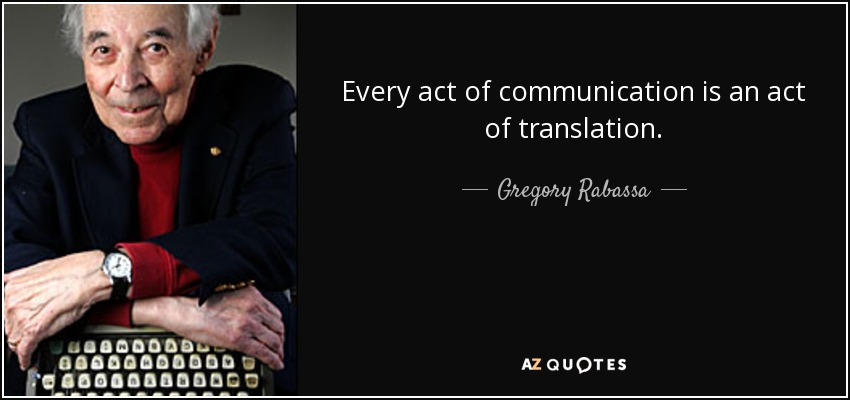
Every act of communication is an act of translation.
When you begin to read a poem you are entering a foreign country whose laws and language and life are a kind of translation of your own; but to accept it because its stews taste exactly like your old mother's hash, or to reject it because the owl-headed goddess of wisdom in its temple is fatter than the Statue of Liberty, is an equal mark of that want of imagination, that inaccessibility to experience, of which each of us who dies a natural death will die.
No one really knew the sciences except the Lord Robert, Bishop of Lincoln, by reason of his length of life and experience, as well as of his studiousness and zeal. He knew mathematics and perspective, and there was nothing which he was unable to know; and at the same time he was sufficiently acquainted with languages to be able to understand the saints and the philosophers and the wise men of antiquity but his knowledge of languages was not such as to enable him to effect translations until the latter portion of his life.
A translation in verse . . . seems to me something absurd, impossible.
In its happiest efforts, translation is but approximation, and its efforts are not often happy. A translation may be good as translation, but it cannot be an adequate reproduction of the original.
A major difficulty in translation is that a word in one language seldom has a precise equivalent in another one.
We live in a world ruled by fictions of every kind - mass merchandising, advertising, politics conducted as a branch of advertising, the instant translation of science and technology into popular imagery, the increasing blurring and intermingling of identities within the realm of consumer goods, the preempting of any free or original imaginative response to experience by the television screen. We live inside an enormous novel.
Refined, intense, wise, stiring, immediate, subtile, all the charmed qualities gather in Dropping the Bow. These translations are precious jewels. Like the erotic moods they investigate, these versions shimmer and startle with a palpable desire to be heard, and a mystical sense of impermanence. This is a transmission of a vital, extraordinary tradition.
These are crystalline - oftentimes incandescent - translations of Juarroz's powerful metaphysical poems where eternity and silence jut up against a world where “writing infects the landscape” and there are “more letters than leaves” - The kind of match one hopes for where both the translator and the poet are in luck; new poems which don't leak and yet old poems in which the original passion shines.
The vices and the virtues are written in a language the world cannot construe; it reads them in a vile translation, and the translators are Failure and Success.
[On the New Testament:] I ... must enter my protest against the false translation of some passages by the men who did that work, and against the perverted interpretation by the men who undertook to write commentaries thereon. I am inclined to think, when we [women] are admitted to the honor of studying Greek and Hebrew, we shall produce some various readings of the Bible a little different from those we now have.
Drill in exact translation is an excellent way of disposing the mind against that looseness and exaggeration with which the sensationalists have corrupted our world. If schools of journalism knew their business, they would graduate no one who could not render the Greek poets.
I have made a very rude translation of the Seven against Thebes, and Pindar too I have looked at, and wish he was better worth translating. I believe even the best things are not equal to their fame. Perhaps it would be better to translate fame itself,--or is not that what the poets themselves do? However, I have not done with Pindar yet.
Faction is the greatest evil and the most common danger. "Faction" is the conventional English translation of the Greek stasis, one of the most remarkable words to be found in any language.
The heroic books, even if printed in the character of our mother tongue, will always be in a language dead to degenerate times; and we must laboriously seek the meaning of each word and line, conjecturing a larger sense than common use permits out of what wisdom and valor and generosity we have. The modern cheap and fertile press, with all its translations, has done little to bring us nearer to the heroic writers of antiquity. They seem as solitary, and the letter in which they are printed as rare and curious, as ever.
I'm interested in the murky areas where there are no clear answers - or sometimes multiple answers. It's here that I try to imagine patterns or codes to make sense of the unknowns that keep us up at night. I'm also interested in the invisible space between people in communication; the space guided by translation and misinterpretation.
Above all, the translation of books into digital formats means the destruction of boundaries. Bound, printed texts are discrete objects: immutable, individual, lendable, cut off from the world.
If you just read the book, you're taking in the narrative, you're taking in the characters, you're understanding it in a certain way. If you make a movie it's really an act of translation.
The New York Times is the worst in that hardly anybody can write English over there. Most of it reads like slight translations from the German.
To be frank: the translations that often sound bad in the mouths of the actors, these have often been done by linguists.
The translation process becomes a highly subjective thing - turning reds and blues into black-and-whiteness. It's really bizarre for me.
The labours I devoted between 1888 to 1900 to the critical edition, translation and commentary of Kalhana's Rajatarangini, the only true historical text of Sanskrit literature, afforded me ample opportunities of gaining close contact with Sanskrit savants of Kashmir, the land where traditional learning of Hindu India had flourished in old times greatly and survived until recent years.
Khairani Barokka is a writer, spoken-word poet, visual artist and performer whose work has a strong vein of activism, particularly around disability, but also how this intersects with, for example, issues of gender - she's campaigned for reproductive rights in her native Indonesian, and is currently studying for a PhD in disability and visual cultures at Goldsmiths. She's written a feminist, environmentalist, anti-colonialist narrative poem, with tactile artwork and a Braille translation. How could I not publish that?
Well, the role of our "allies," in my view, is a scandal. 53 other countries cooperated in the kidnapping, "extraordinary rendition," of suspected terrorists to black sites where they were administered enhanced interrogation techniques, which by the way is a direct, literal translation of "verschärfte Vernehmung" right out of the Gestapo manual.
Some of my colleagues are surprised by how little personal interaction I've had with "my" authors, but I don't translate to go fishing for friends. Part of me suspects that they wouldn't like me, or that I wouldn't like them, which would inevitably get in the way of the mission. None of the theory built around translation matters to me anyway: much of the process, I find, is intuitive.
Follow AzQuotes on Facebook, Twitter and Google+. Every day we present the best quotes! Improve yourself, find your inspiration, share with friends
or simply: