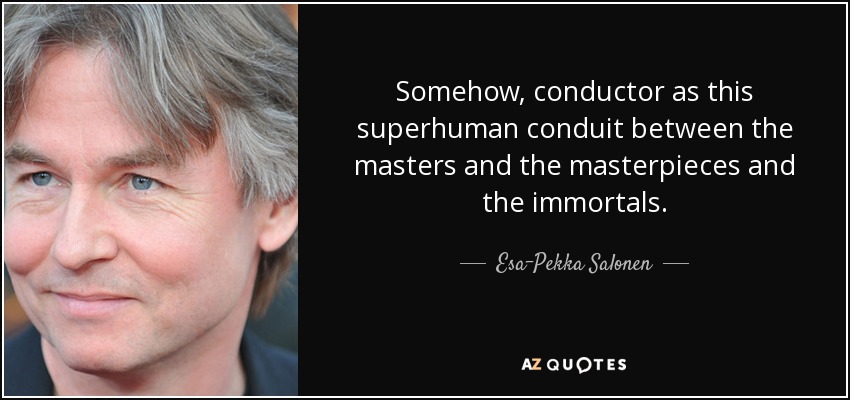
Somehow, conductor as this superhuman conduit between the masters and the masterpieces and the immortals.
The intensity of being in front of all these incredible musicians and tremendous conductors in these elaborate halls can be overwhelming.
It is so powerful when we can leave behind our ordinary identities, no longer think of ourselves primarily as a conductor, or writer, or salesclerk, and go to a supportive environment to deeply immerse in meditation practice.
If you're not filled back up quickly, you might collapse like a birthday balloon". I guess that's why acting is so addictive. For the director, that addiction will come from the love and trust he gets from the "orchestra", him being the conductor. That's why many directors fall in love with their leading lady/man: having someone say "how do you want me to be" is incredible.
There's a metal train that a mile long and at the very back end a lightning bolt struck her. How long til it reaches and kills the driver, provided that he's a good conductor?
Years ago, I heard an interview with violinist Yehudi Menuhin. The interviewer said, "Do you still practice?" And he said, "I practice every day." He said, "If I skip a day, I can hear it. If I skip two days, the conductor can hear it. And if I skip three days, the audience can hear it." Oh, yes, you have to keep that muscle firm.
Never wanted to do anything else than acting ever in my life. But I'm 20, and there's so many possibilities. It would be insane for me to say, "Yeah this is definitely it, I'm never doing anything else." I'm 20 years old. I don't know what I'm doing. I don't know anything about life. So I don't know. I may be a train conductor in 10 years. I have no idea. And that's the joy of this all.
I had a tough childhood, yes. I was born in rural Bangladesh to parents who had had no education beyond high school. We moved to the UK where I grew up in poverty, in some of the worst conditions in a developed economy, before moving to the projects - heaven - and I went to unremarkable schools before going to university. My father was a bus conductor first and then a waiter, and my mother a seamstress.
Zeal, the blind conductor of the will.
Increasingly I think of myself as some strange and solitary conductor, introduced to a group of very dynamic musicians who happen to be my characters, and I have no idea how they are going to play together, and I have certainly no idea how I am going to put manners on them.
I urge pupils when studying a work and in order to master its most important aspic, the rhythmic structure, or the ordering of the time process, to do just what a conductor does with the score: to place music on the desk and to conduct the work from beginning to end as if it were played by someone else, an imaginary pianist with the conductor trying to impress him with his will, his tempo first of all, plus all the details of his performance.
The eloquence of one stimulates all the rest, some up to the speaking-point, and all others to a degree that makes them good receivers and conductors, and they avenge themselves for their enforced silence by increased loquacity on their return.
I'm a geek and I'm a nerd, and I can listen into any piece of music. I think, I can usually tell you what orchestra it was, I can usually tell you what hall it was in. I can tell you, obviously who the conductor was, and who the composer was.
This year - a factory of semiconductors. Next year - a factory of whole conductors!
Direction is the most invisible part of the theatrical art. It's not like the conductor in the symphony orchestra performance because he's standing in front of you waiving his arms. You now what he's doing. You don't know what the director is doing unless you know a lot about theater and even then you can only deduce it. You know it when you go to rehearsal. You really know it when they are rehearsing something of yours. I learned more in the rehearsals for The Letter than I have ever dreamed of know in the theater as a critic. If it doesn't make me a better critic, I'm an idiot.
When I got out of college I moved to Seattle because it was the nearest big city and still didn't know if I wanted to be a composer, conductor, singer, actor. I just got day jobs and auditioned and took what came and the theater doors were the ones opening the most.
People have an affinity towards things, and you don't know where it comes from. Mozart wrote a symphony when he was four, so it's said; the theory is maybe because his father was a conductor, it happened in vitro, and he heard the music before he was born, and by the age of four he knew how to write music.
A conductor should reconcile himself to the realization that regardless of his approach or temperament the eventual result is the same-the orchestra will hate him.
In truth, I became a conductor because deep down I wanted to conduct Brahmss four symphonies and Richard Strausss tone poems.
The singers all loathe the sight of one another, the chorus despises the singers, they both hate the orchestra, and everyone fears the conductor; the staff on one prompt side won't talk to the staff on the opposite prompt side, the dancers are all crazed from hunger in any case.
Directors have a tendency to use their hands like orchestra conductors. They don't realize that the actor is looking at their faces, anyway.
Men of extraordinary success, in their honest moments, have always sung, "Not unto us, not unto us." According to the faith of their times, they have built altars to Fortune, or to Destiny, or to St. Julian. Their success lay in their parallelism to the course of thought, which found in them an unobstructed channel; and the wonders of which they were the visible conductors seemed to their eye their deed.
Today's parents have little authority over those others with whom they share the task of raising their children. On the contrary,most parents deal with those others from a position of inferiority or helplessness. Teacher, doctors, social workers, or television producers possess more status than most parents.... As a result, the parent today isa maestro trying to conduct an orchestra of players who have never met and who play from a multitude of different scores, each in a notation the conductor cannot read.
The conductor is a peculiar person. He turns his back on his friends in the audience, shakes a stick at his players in the orchestra, and then wonders why nobody loves him.
I had a year at 3 when I wanted to be a conductor in the opera.
Follow AzQuotes on Facebook, Twitter and Google+. Every day we present the best quotes! Improve yourself, find your inspiration, share with friends
or simply: