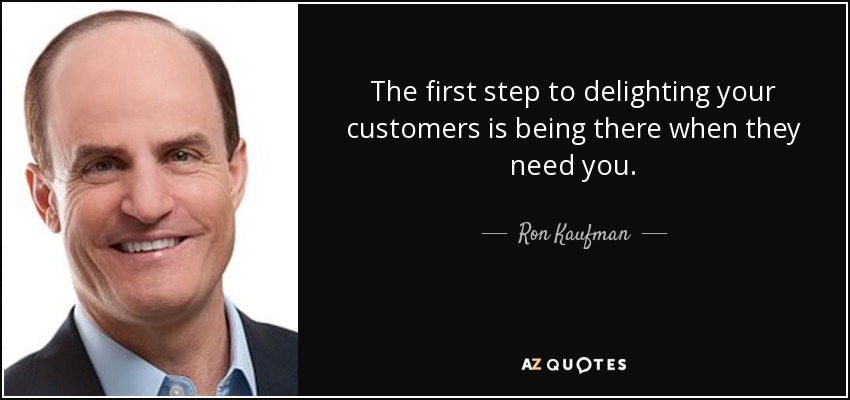
The first step to delighting your customers is being there when they need you.
No one ever delighted a customer by being 'good enough'.
Good customers want good quality service. Great customers want it even more.
When customers' expectations change faster than your willingness or ability to serve them, you can be sure they'll be someone else's customers soon.
If your incentives are set up wrong - if for some reason you reward people for behavior that's actually bad for your customers or your organization - then you're going to encourage that behavior.
You have to be willing to spend an awful lot in that R&D phase before you see the benefits. When you look at the companies that have really won customers over in technology - say, Apple and Google - you find that they spend billions of dollars on R&D each year, often spending that much on a product before they ever make a dime back in profits.
Don't let high-speed completely replace high-touch. Your customers may appreciate both.
A: Set the pace and rule the race. Seek new ways to differentiate, new ways to surprise and delight your customers.
The bottom line is a by-product of taking care of your main product - your customers.
Rather than focus on trying to get a lot of customers to market yourself, really focus more on the actual product or service itself and existing users to, like, what would make them happier, what would make them come back more and more times or in our case buy more often.
I think the way design was practiced for most of the 20th century was very declarative. A designer came up with a solution for a project and put it in place and shipped the solution and it landed in a reader or a customer's hands as a brochure. They would see it as a poster, or as a piece of signage. And that was sort of it. That was the end of it. I think Internet technology has really upended that whole equation because in some ways a designer's work is never really done online.
One day I went to the manager and I asked him whether his model was working and he said, "Well, haven't you seen how many customers we have in this store?" And yes indeed I had. I mean it was definitely attracting a lot of customers, even attracting tourist buses that would land up at this store and people would go through the store and marvel at all the options, even sometimes take photographs of the various aisles.
I'm not targeting government. I'm not saying hey, I'm closing it because I don't want to give you any data. I'm saying that to protect out customers, we have to encrypt. And a side affect of that is, I don't have the data.
When you're managing a large number of people, you learn that incentives matter tremendously. You really want people to be rewarded for doing the right thing for the customers and the organization.
Occasionally problems will occur. When it happens to your customers, fix the problem fast. Make it your speed and generosity that gets remembered, not the problem.
The right measure is not how many customers you've got, but how closely you hold them.
When the customer makes contact, he does not want a quote. He wants a commitment.
There are multiple ways to be externally focused that are very successful. You can be customer-focused or competitor-focused. Some people are internally focused, and if they reach critical mass, they can tip the whole company.
The objective.. is to achieve a comfort level between the cook/artist/performer and the customer/viewer/diner. And if we can achieve that, and the customers are happy and the cooks are happy, then we have a great experience.
Having your own store is one of the most immediate ways to connect with the customer, to really get to know her and develop a more intimate relationship.
I think a much better use of time and resources is to really focus on your existing users or customers and figure out what changes can you make in the Web site, the service, the product, whatever, to get them to come back more often to generate that repeat business and once you kind of figure out that formula, then when you get new customers the whole thing just kind of grows exponentially.
Given the increasing diversity among customers and employees, organizations that attend to cultural intelligence are more successful.
Banks also have to say no to customers. We can't always give clients what they want; it may not be in the client's best interest.
People need to understand: Businesses are going to make mistakes. They shouldn't be shot and hung every time. We should apologize for it. We should make up for it. My shareholders paid for it. No customer was hurt, which is critical to me. But I hurt my shareholders, and I wish I hadn't.
I want you to say to me right from the start, "We are here to serve customers. We're not here for me to make a lot of money. We're not here to bet on interest rates or credit spreads. We are here to serve our customers really well over a long period of time, and that's how you build a successful business." And so I want to see that, too, you know?
Follow AzQuotes on Facebook, Twitter and Google+. Every day we present the best quotes! Improve yourself, find your inspiration, share with friends
or simply: