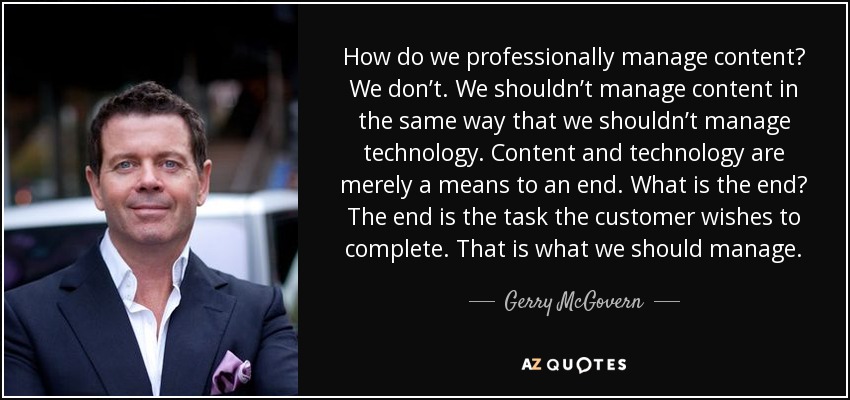
How do we professionally manage content? We don’t. We shouldn’t manage content in the same way that we shouldn’t manage technology. Content and technology are merely a means to an end. What is the end? The end is the task the customer wishes to complete. That is what we should manage.
It's actually as simple as this. New authors, building their customer base, need physical bookshops. Physical bookshops are lovely tactile, friendly, expert, welcoming places. Physical books, which can only be seen and handled in physical bookshops, are lovely, tactile things. Destroy those bookshops, and the very commercial and cultural base to the book industry is destroyed. Once and for all. Like Humpty Dumpty, it can never be put together again.
Never forget that you only have one opportunity to make a first impression - with investors, with customers, with PR, and with marketing.
You've got to start with the customer experience and work backwards to the technology. You can't start with the technology and try to figure out where you're going to sell it.
Innovation has stalled in the banking industry. While the rest of the world is in the digital age, banking remains stagnant. We are here to change this and bring banking to the 21st century. We will ensure our customers feel involved in the progress of this bank and are offering them a truly enjoyable banking experience – different from anything they have experienced before.
The competitor is our friend and the customer is our enemy.
The objective.. is to achieve a comfort level between the cook/artist/performer and the customer/viewer/diner. And if we can achieve that, and the customers are happy and the cooks are happy, then we have a great experience.
If you don't keep giving customers reasons to buy from you, they won't
I'm building a glass pyramid over the Egyptian escalator where my body will be mummified, so my customers can come and see me forever.
Instead of creating aesthetically pleasing prose, you have to dig into a product or service, uncover the reasons why consumers would want to buy the product, and present those sales arguments in copy that is read, understood, and reacted to—copy that makes the arguments so convincingly the customer can’t help but want to buy the product being advertised.
If it is your assignment to write copy for a product or service that you really don’t have a feel for, then you have a great deal of studying to do to make sure you understand who your customer is and what motivates him or her.
On the Internet, it's survival of the easiest.... Give users a good experience and they're apt to turn into frequent and loyal customers. But ... it's easy to turn to another supplier in the face of even a minor hiccup. Only if a site is extremely easy to use will anybody bother staying around.
The web is the ultimate customer-empowering environment. He or she who clicks the mouse gets to decide everything. It is so easy to go elsewhere; all the competitors in the world are but a mouseclick away.
Usability rules the web. Simply stated, if the customer can't find a product, then he or she will not buy it.
Customer will create most value for you at point he thinks you're creating most value for him.
Self-Checkout Line The place where customers of an establishment become unpaid employees of the establishment.
Good service leads to multiple sales. If you take good care of your customers, they will open doors you could never open by yourself.
Any time a customer comes into contact with any aspect of a business, however remote, is an opportunity to form an impression.
If you want to measure social media ROI, stop wasting your time doing software demos and attending webinars. Just figure out what you want to track, where you can track it, think about both current customers and new customers, and go do it.
Hierarchy is an organization with its face toward the CEO and its ass toward the customer.
Well, I kind of think that the opposite is true. The customer is rarely right. And that is why you must seize the control of the circumstance and dominate every last detail: to guarantee that they're going to have a far better time than they ever would have had if they tried to control it themselves.
The secret of successful retailing is to give your customers what they want. And really, if you think about it from the point of view of the customer, you want everything: a wide assortment of good quality merchandise; the lowest possible prices; guaranteed satisfaction with what you buy; friendly, knowledgeable service; convenient hours; free parking; a pleasant shopping experience.
You can't keep putting the same stuff on all these channels, or it's going to get annoying. We need to aim for 'distinctive ubiquity,’ so we need to be everywhere but we need to continue to surprise and delight our customers in a relevant and consistent way wherever they are.
I have always felt that public, commercial and community organisations should be as open as possible about their affairs. They need to be accountable to their owners, their customers, their members and communities and other interest groups.
What is good for our customers is also in the long run good for us.
Follow AzQuotes on Facebook, Twitter and Google+. Every day we present the best quotes! Improve yourself, find your inspiration, share with friends
or simply: