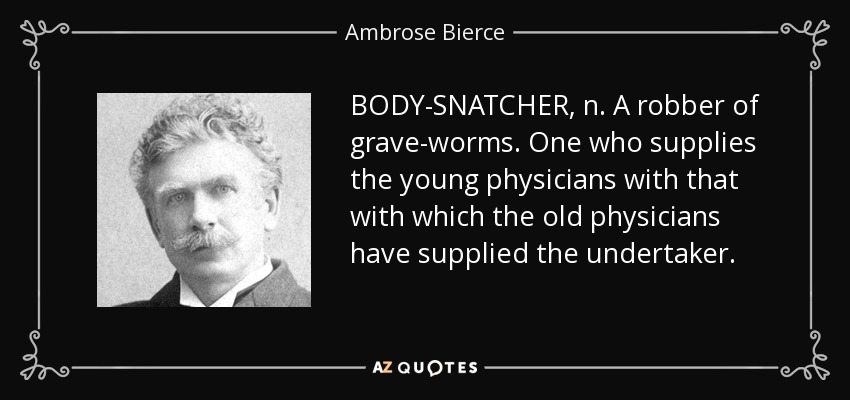
BODY-SNATCHER, n. A robber of grave-worms. One who supplies the young physicians with that with which the old physicians have supplied the undertaker.
MOUSE, n. An animal which strews its path with fainting women.
Prudent people are very happy; 'tis an exceeding fine thing, that's certain, but I was born without it, and shall retain to my day of Death the Humour of saying what I think.
MEDICINE, n. A stone flung down the Bowery to kill a dog in Broadway.
POTABLE, n. Suitable for drinking. Water is said to be potable; indeed, some declare it our natural beverage, although even they find it palatable only when suffering from the recurrent disorder known as thirst, for which it is a medicine. Upon nothing has so great and diligent ingenuity been brought to bear in all ages and in all countries, except the most uncivilized, as upon the invention of substitutes for water. To hold that this general aversion to that liquid has no basis in the preservative instinct of the race is to be unscientific-and without science we are as the snakes and toads.
GRAVE, n. A place in which the dead are laid to await the coming of the medical student.
PHYSICIAN, n. One upon whom we set our hopes when ill and our dogs when well.
IMAGINATION, n. A warehouse of facts, with poet and liar in joint ownership.
BIRTH, n. The first and direst of all disasters. As to the nature of it there appears to be no uniformity. Castor and Pollux were born from the egg. Pallas came out of a skull. Galatea was once a block of stone. Peresilis, who wrote in the tenth century, avers that he grew up out of the ground where a priest had spilled holy water. It is known that Arimaxus was derived from a hole in the earth, made by a stroke of lightning. Leucomedon was the son of a cavern in Mount Etna, and I have myself seen a man come out of a wine cellar.
It is well-known what a middleman is: he is a man who bamboozles one party and plunders the other.
Throughout the history of commercial life nobody has ever quite liked the commission man. His function is too vague, his presence always seems one too many, his profit looks too easy, and even when you admit that he has a necessary function, you feel that this function is, as it were, a personification of something that in an ethical society would not need to exist. If people could deal with one another honestly, they would not need agents.
But to the particular species of excellence men are directed, not by an ascendant planet or predominating humour, but by the first book which they read, some early conversation which they heard, or some accident which excited ardour and emulation.
I've always been an optimist and I believe laughter is a wonderful thing
LECTURER, n. One with his hand in your pocket, his tongue in your ear and his faith in your patience.
I think that London is very much like that. I find there's humour in the air and people are interesting. And I think that it's a place which is constantly surprising. The worst thing about it? I think it can be smug and aggressive.
To run this business ... you need ... optimism, humanism, enthusiasm, intuition, curiosity, love, humour, magic and fun, and that secret ingredient-euph oria.
MESMERISM, n. Hypnotism before it wore good clothes, kept a carriage and asked Incredulity to dinner.
GUILLOTINE, n. A machine which makes a Frenchman shrug his shoulders with good reason.
As Aboriginal people we have always retained our resilience, our humour and our cultural integrity - we will always retain our dreams and a vision for the future for our people.
A sense of humour is a sense of proportion.
Faeries are not fantasy, but a connection to reality. Faeries are irrational, poetic, absurd, and very, very wise. Faeries say there is nonsense in dogma, and sense in nonsense. Faeries express themselves with high seriousness and low humour. Faeries are resistant to all definitions.
PROOF, n. Evidence having a shade more of plausibility than of unlikelihood. The testimony of two credible witnesses as opposed to that of only one.
RADIUM, n. A mineral that gives off heat and stimulates the organ that a scientist is a fool with.
RAILROAD, n. The chief of many mechanical devices enabling us to get away from where we are to where we are no better off. For this purpose the railroad is held in highest favor by the optimist, for it permits him to make the transit with great expedition.
TELESCOPE, n. A device having a relation to the eye similar to that of the telephone to the ear, enabling distant objects to plague us with a multitude of needless details. Luckily it is unprovided with a bell summoning us to the sacrifice.
Follow AzQuotes on Facebook, Twitter and Google+. Every day we present the best quotes! Improve yourself, find your inspiration, share with friends
or simply: