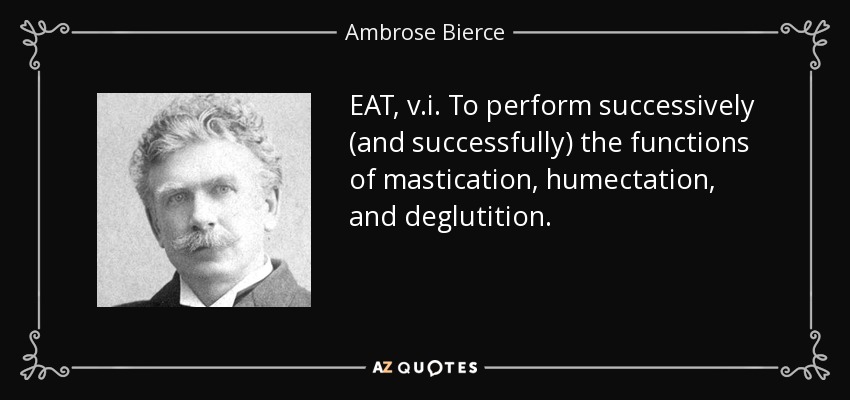
EAT, v.i. To perform successively (and successfully) the functions of mastication, humectation, and deglutition.
FROG, n. A reptile with edible legs
GOOSE, n. A bird that supplies quills for writing. These, by some occult process of nature, are penetrated and suffused with various degrees of the bird's intellectual energies and emotional character, so that when inked and drawn mechanically across paper by a person called an "author," there results a very fair and accurate transcript of the fowl's thought and feeling. The difference in geese, as discovered by this ingenious method, is considerable: many are found to have only trivial and insignificant powers, but some are seen to be very great geese indeed.
GRAVITATION, n. The tendency of all bodies to approach one another with a strength proportioned to the quantity of matter they contain-the quantity of matter they contain being ascertained by the strength of their tendency to approach one another. This is a lovely and edifying illustration of how science, having made A the proof of B, makes B the proof of A.
GUNPOWDER, n. An agency employed by civilized nations for the settlement of disputes which might become troublesome if left unadjusted. By most writers the invention of gunpowder is ascribed to the Chinese, but not upon very convincing evidence. Milton says it was invented by the devil to dispel angels with, and this opinion seems to derive some support from the scarcity of angels.
HIBERNATE, v. i. To pass the winter season in domestic seclusion. There have been many singular popular notions about the hibernation of various animals. Many believe that the bear hibernates during the whole winter and subsists by mechanically sucking its paws. It is admitted that it comes out of its retirement in the spring so lean that it has to try twice before it can cast a shadow.
HOMŒOPATHIST, n. The humorist of the medical profession.
LEAD, n. A heavy blue-gray metal much used ... as a counterpoise to an argument of such weight that it turns the scale of debate the wrong way. An interesting fact in the chemistry of international controversy is that at the point of contact of two patriotisms lead is precipitated in great quantities.
LIVER, n. A large red organ thoughtfully provided by nature to be bilious with. The sentiments and emotions which every literary anatomist now knows to haunt the heart were anciently believed to infest the liver; and even Gascoygne, speaking of the emotional side of human nature, calls it "our hepaticall parte." It was at one time considered the seat of life; hence its name- liver, the thing we live with.
MOUSE, n. An animal which strews its path with fainting women.
OBSERVATORY, n. A place where astronomers conjecture away the guesses of their predecessors.
PROOF, n. Evidence having a shade more of plausibility than of unlikelihood. The testimony of two credible witnesses as opposed to that of only one.
RADIUM, n. A mineral that gives off heat and stimulates the organ that a scientist is a fool with.
RAILROAD, n. The chief of many mechanical devices enabling us to get away from where we are to where we are no better off. For this purpose the railroad is held in highest favor by the optimist, for it permits him to make the transit with great expedition.
TELESCOPE, n. A device having a relation to the eye similar to that of the telephone to the ear, enabling distant objects to plague us with a multitude of needless details. Luckily it is unprovided with a bell summoning us to the sacrifice.
A story, in which native humour reigns, Is often useful, always entertains; A graver fact, enlisted on your side, May furnish illustration, well applied; But sedentary weavers of long tales Give me the fidgets, and my patience fails.
Any man will admit if need be that his sight is not good, or that he cannot swim or shoots badly with a rifle, but to touch upon his sense of humour is to give him mortal affront.
My favourite writer is Beckett and I keep going back to wallow in his work like a deep pool of dark humour or like an oxygen tank when you can't breath in a world consumed by piety, hypocrisy and self-satisfaction.
I think the French have a romantic cliche that Englishmen have great style, great music, irony and sense of humour. Well, sometimes cliches are true.
Abstain from beans. There be sundry interpretations of this symbol. But Plutarch and Cicero think beans to be forbidden of Pythagoras, because they be windy and do engender impure humours and for that cause provoke bodily lust.
We've had a day of great drama and of humour too. The rumour mill is now taking over
Humour is completed by an audience.
For the purposes of life and conduct, and society, a little good sense is surely better than all this genius, and a little good humour than this extreme sensibility.
Religion supposed Heaven and Hell, the word of God, and sacraments, and twenty other circumstances which, taken seriously, are a wonderful check to wit and humour.
But you must still know to respect other people's faith.' 'Why? We don't respect any other delusion. We lock up people who believe they're Christ, yet we're supposed to humour those who believe in him.' 'By definition, faith is irrational: a belief you hold against the normal rules of evidence.' 'In which case I believe in Jedi
Follow AzQuotes on Facebook, Twitter and Google+. Every day we present the best quotes! Improve yourself, find your inspiration, share with friends
or simply: