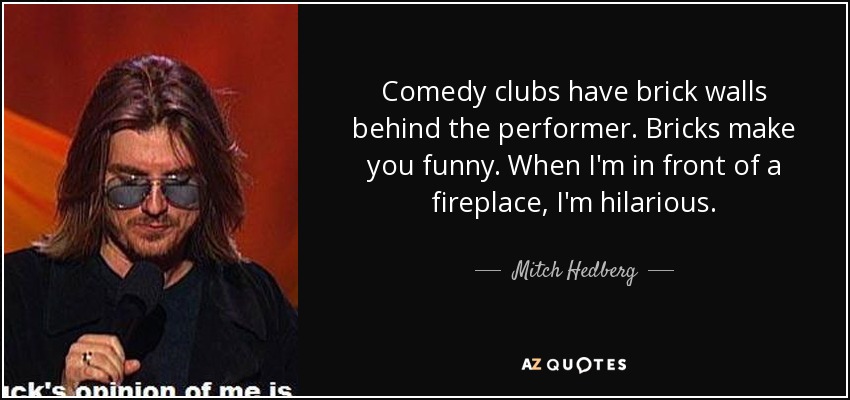
Comedy clubs have brick walls behind the performer. Bricks make you funny. When I'm in front of a fireplace, I'm hilarious.
Comedy clubs are sacred ground. That's where anything goes.
I started doing stand-up at the age of 20. This was back in 1976, around the time (coincidence?) that the first comedy clubs were starting. The young comedians of today gasp when I tell them how many shows I did that first year: 500. Five nights a week.
When I was a child, I wanted to watch things that made me laugh. It's attacking boredom, as simple as that. I was 19 when I first went to a comedy club - I wanted to do it, so I gave it a try and that was it. I found my office.
I think the comedy clubs tend to homogenize the acts a little bit, because they force them to be palatable in way too many environments.
I didn't take anything from anyone - first of all. Second of all, I opened a comedy club with money that I saved over 25 years. I created jobs.
When I was in third grade I taught myself ventriloquism... What's hard is to learn to be an entertainer and make people laugh. I was a few years out of college before I felt I had enough material. Then in 1988 I moved to L.A. and started to do some shows at comedy clubs.
I was in NYC during 9/11; it happened on a Tuesday, I was on stage Thursday. It was a small crowd, but it took about 10 days and comedy clubs were packed.
When I dropped out [from a law school], everybody was disappointed... But I found that disappointing people is a good thing, because disapproval is freedom. Before that, I never realized how much I sought other people's approval. Once I figured that out, I was free to move on and seek the approval of other people, in comedy clubs and showbiz meetings.
Even though I have fond feelings for comedy clubs, I enjoy the focus you get in a theater. Comedy clubs are a different animal. People are being served nachos and there's a blender going off in the background.
In my Comedy Club sets, I just work on what is fresh and try to build that show as long as I can. I don't like to do burnt material on stage. Even though my crowd loves to hear me do old stuff, I don't like to do old stuff.
I used to go to the Cleveland Comedy Club all the time. If there was a comic I liked, I'd go see him two or three times that week. Bob Saget was one of those guys.
Every time I've done comedy in, like, traditional comedy clubs, there's always these comedians that do really well with audiences but that the other comedians hate because they're just, you know, doing kind of cheap stuff like dancing around or doing, like, very kind of base sex humor a lot, and stuff like that.
Bob Saget was known, in the comedy clubs in those days, as extremely funny but with dark humor. It was always an inside joke among comics, when he got Full House, it was, like, wow, hes playing this all-American dad kind of thing. That was not Bob Saget. His comedic style is definitely more twisted, and he has an edgier side than he showed in Full House.
There's nothing like the energy in a small comedy club room or a small theater when it's going really well. I can see everybody's face practically in the whole room. There's no cameras in the way, and it's just me.
TV is easier: it's all planned out for you, and the audience is there to see a show and they are all pumped up, but when you are in a comedy club, you have to be really funny to win them over. To me, that's more pure.
Years have passed since I have set foot in a comedy club. If the comic is doing badly it's painful, and if the comic is doing brilliantly, it's extremely painful.
I went to a performance-art high school, and a teacher there was signing me up for open-mic nights at the comedy club. I think about it now, and I think, 'Well, that may be inappropriate,' but it was great!'
I used to go to the Improvisation Comedy Club every night in Times Square. How I didn't get killed in that area either means that 1) God is watching over me or 2) I am so insignificant to God that he didn't bother having me killed.
A comedy club is a place where you work out material, you're trying material.
I'll go back to comedy clubs when they get a real no-camera policy, the same way they did with smoking.
If I had to perform in a comedy club I would bomb; I would be trying too hard.
I started selling out comedy clubs before I got to town with no advertising. I was selling out theaters just on the rumor that I was going to be there.
When I hit my 20s, I struggled to make it. I got married at 19, and my daughter, Je'Niece, was born a year later. I worked blue collar jobs during the day and comedy clubs at night, and I was earning about $25 a year doing stand-up.
It's depressing sitting at a comedy club all night, waiting to get on to do your five or ten minutes of material.
Follow AzQuotes on Facebook, Twitter and Google+. Every day we present the best quotes! Improve yourself, find your inspiration, share with friends
or simply: