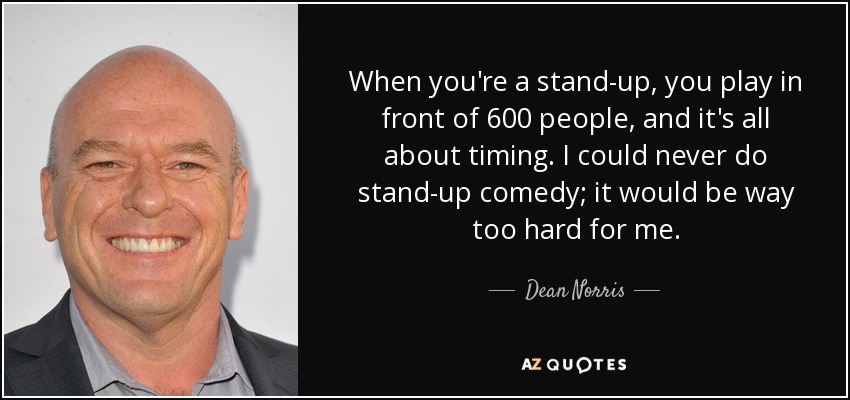
When you're a stand-up, you play in front of 600 people, and it's all about timing. I could never do stand-up comedy; it would be way too hard for me.
I really think if you take away a character's obstacles then there's no comedy.
I think comedy has to be an intellectual pursuit. It comes down to logic and analysis. As soon as it becomes emotional, it's not comedy anymore.
New York now leads the world's great cities in the number of people around whom you shouldn't make a sudden move.
There is a point in portraying surface vulgarity where tragedy and comedy are very close.
A long, exact, and serious comedy; In every scene some moral let it teach, And, if it can, at once both please and preach.
Linda Brewer's example is inspiring, colorful and potentially very funny. Her journey also exists firmly in the Heartland tradition of American success stories and comedies.
When someone who is known for being comedic does something straight, it's always "a big breakthrough" or a "radical departure." Why is is no one ever says that if a straight actor does comedy? Are they presuming comedy is easier?
I'm just trying to make a smudge on the collective unconscious.
Iraq's elite Republican Guard is doing so badly they're changing their name to the Democratic Guard.
Wherever we've travelled in this great land of ours, we've found that people everywhere are about 90% water.
The most important thing in comedy - apart from empathy, which I think is important even if disguised - is surprise. I like surprising people with the fact that something's even a joke at all.
If you look at the films that I've done generally, you would probably get an idea of what I'm most interested in, and if ever I do something unusual like a science fiction film or an action film or a comedy or something, then that to me feels like a step to the side to do something different.
It's fun for me to couple emotion with comedy. I think it helps comedy. I think a lot of times American comedies don't play on emotion too much.
I don't want to be a facilitator for other funny people. It doesn't seem smart for me to be in a comedy and not be funny. My spirit can't take it.
I was fifteen, or sixteen. I was in high school. I was spending a summer in California with my second cousins. And I wanted to be a director really bad. I was making a lot of 8mm home movies, since I was twelve, making little dramas and comedies with the neighborhood kids.
As a comedian I appreciate every kind of comedy. You decide for yourself what you're going to do.
I drank the Kool-Aid of being a network star. Once it didn't happen, I realized it wasn't the best version of my comedy.
I believe that people, more often than not, act with the best possible intentions. And when they don't, that's funny to me. That's why comedy ends up seeming cynical, because you're talking about the gap between what people say and what they do.
The more you progress, the more you learn. I try to pay attention to ticket counts, draws, guarantees and bonuses. I look at my deals closely these days and try to come up with other projects and ideas, since this business [comedy] is about creating content.
Comedy is a very delicate business, especially comedies that sort of attempt to do things in an honest way and in a very naturalistic way the way that 'No Strings Attached' is.
I'm not a professional comedian. Nobody comes to my comedy shows. That's just a little hobby.
I don't like stand-up comedy that requires a lot of props. I really respect people who can walk out onstage alone and with no other tool but their own minds and can make you laugh and maybe even think a little.
Comedy is the most palliative way to make a point. People are more willing to listen if they can laugh.
You don't have to be inspired by comedians. You have to be inspired by things that are real, whether it's music, comedy...a movie - that should inspire you.
Follow AzQuotes on Facebook, Twitter and Google+. Every day we present the best quotes! Improve yourself, find your inspiration, share with friends
or simply: