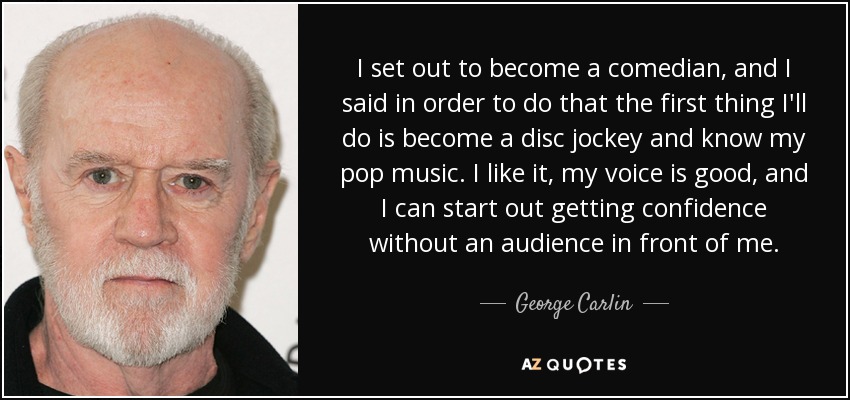
I set out to become a comedian, and I said in order to do that the first thing I'll do is become a disc jockey and know my pop music. I like it, my voice is good, and I can start out getting confidence without an audience in front of me.
When you start in the childhood period, when you begin to form a comic sense, it was the radio comedians - from the last days of radio and the first days of television. And Spike Jones. And the Marx Brothers. They represented anarchy. They took things that were nice and decent and proper, and they tore them to shreds. That attracted me.
A friend of mine is trying to do a documentary where he brings Jewish and Arab comedians to occupied territories in Israel. He wants to do shows as a way of finding some comedic common denominator. When he proposed the idea to one of the officials at the Jenin refuge camp, the guy just stared at him and said, "This is not a joke to us. We don't think that laughing is the answer."
Some comedians you work with, they only turn on when the camera turn on, and they're like sad-faced clowns when the camera's off. And then, they come alive when the camera come on. And you be like, "Oh, damn. You're not a depressed ball of depression, but you are actually funny."
Because of my comedic-influence growing up, Mel Brooks, Jim Carrey, Steve Martin… A lot of Jeff comedic-influences included Charlie Chaplin and physical comedians of the silent-era. What we were able to do together is to show all these major influences but make it into our own comedy. We've seen the stereotypical boy-meets-girl story a hundred thousand times…
I think it's kind of crazy that we're still calling comedians "female comedians." That seems more like a sneak attack.
On the other side of the spectrum, you see someone like Donald Trump, who is using as the basis of his campaign political incorrectness. It's clearly intentional. He'd have to be a complete moron just to coincidentally insult Mexicans, and women, and disabled people, and Muslims. So clearly he's using it as a vote winner. But I think with comedians there's a responsibility.
I think a lot of actors, comedians, musicians, artists are drawn to this world, because you're allowed to excavate whatever it is that you're struggling with, and hopefully turn it into art.
I am a comedian and I started in stand-up when I was 22.
Although I had good hand-eye coordination, I was so tall and skinny and muscularly weak that I just was not well coordinated. But what I started to do quite early on was watch some of the great old silent comedians, like Laurel and Hardy and Chaplin, and then later on Harold Lloyd and Buster Keaton.
There are words that I wouldn't say because they hurt people's feelings. I just happen to be a white guy who writes for a lot of black comedians but if I wrote for a lot of gay comedians there might be stuff I would say then.
I came from a very different sort of background and pedigree from the people who were on "The Daily Show". I was an actor. I was sort of - the irony is that I've done as much dramatic work in my career as comedic work and I don't really think of myself as a comedian.
I'm such a fan of Lily's [Tomlin], for so many years. I feel like Lily was the first popular mainstream crossover comedian who also was kind of an overtly feminist comedian.
I have to make good things so good comedians want to talk to me.
I think there is a weird loneliness that comes with being a comedian. There is something definitely inside the personality of a person who wants to be a comedian, and (he or she) is looking to connect (to the audience) at all times.
Outside of performing, (a comedian) is someone who is analyzing life, thinking about it and trying to be observing so much. In my opinion, it can make you feel on the outside looking in.
It's very interesting being an artist and a comedian, (because) you aim for jobs that will feed your ego, but when you get up to the precipice of them, you actually have to deliver. You actually have to understand that you're reaching a new level where there are way more eyes on you, way more expectations and way more pressure.
So many people, my friends and family, were all saying, "You're so funny. Why don't you become a comedian or an actor?" But it wasn't a reality at the time, it wasn't a road that Latin people were accepted in.
I think when I started doing stand-up, that's when I really tried to question everything in my belief system which is - I think a pretty important part of being a comedian is really questioning things.
Even when you hear about a comedian getting married, among comedians, we're always kind of like, what are they doing?
I always remember writing a page of jokes for a comedian and handing it to him backstage at a club and he read it and then took his cigarette lighter and lit the page on...
Even if I wasn't an actress or a comedian, I would be spreading love and laughter [with] whatever I did.
I don't think comedians take advantage of the fact that television and film are visual mediums.
We live in a fun time with so many ways to express yourself, you would be crazy to be a comedian and not check them all out.
In the '80s especially, a lot of comedians felt compelled to stick with what made them famous and those people became caricatures.
Follow AzQuotes on Facebook, Twitter and Google+. Every day we present the best quotes! Improve yourself, find your inspiration, share with friends
or simply: